Read The FIRST EPISODE
Before a lot of STUFF happened, Corvin had simply been a boy who loved numbers the way other children loved dogs, or football, or sweets from the corner shop.
He’d won the national mental mathematics championship in the third grade, standing on a stage far too big for him in shoes his grandmother had polished twice that morning, solving five-digit multiplication in his head faster than the judges could type the answers into their calculators. By six years old he’d been doing sums adults twice his age found difficult. By eight, algebra bored him the way picture books bore older children — not because it was hard, but because it no longer surprised him. Complex algebra, advanced geometry, the strange, elegant language of calculus and derivations, even the practical mathematics engineers used to design bridges and buildings — Corvin moved through all of it with the same easy, absorbed calm that a painter has with a brush, the same quiet joy a musician has at a piano nobody else in the room can properly hear.
What almost no one knew — because Corvin had never told a single soul, not his teachers, not his grandmother, not even his mother — was that by the second grade, he had stopped simply solving other people’s math problems and started inventing his own.
He kept them in a thick, battered notebook he called, only to himself, his thinking diary. Page after page of equations nobody had ever taught him, symbols he’d designed himself to represent ideas that ordinary numbers couldn’t quite hold, whole systems of logic that existed nowhere else in the world except inside that notebook and inside Corvin’s own quiet, careful mind. It was, without him ever quite realizing it, the closest thing to magic that pure mathematics can become, when a mind clever enough and patient enough is left alone with it for long enough.
He kept the diary intensely private. He wasn’t embarrassed by it, exactly — he simply understood, in the instinctive way clever children sometimes understand things before they have words for them, that it was HIS, in a way almost nothing else in his life was fully his, and that showing it to people tended to change the way they looked at him afterward.
Everything had been fine, more or less, until the day his mother told him his father was finally coming home.
His father had been working abroad for years, in some vague, never-quite-explained capacity that Corvin had stopped asking questions about sometime around the fourth grade. The news of his return, last year, had sent the whole small household into a flurry of excitement entirely unlike their usual quiet routine — his grandmother baking for three days straight, his mother humming as she cleaned rooms that were already clean, and finally, a party, friends and family crowded into their overgrown garden with paper lanterns strung between the trees.
It was at that party that ACTUALLY created trouble.
One of his father’s friends — a tall, soft-spoken uncle with narrow eyes and an unusually attentive way of listening — had struck up a conversation with him near the food table, asking easy, friendly questions about school, about numbers, about whether Corvin enjoyed mathematics as much as his father had proudly claimed he did. The man was good at listening. Genuinely, remarkably good, in the particular way that made a quiet, private boy feel, for possibly the first time in his life, truly understood.
Corvin never could quite explain, afterward, why he’d gone and fetched the notebook. Only that it had felt, in that one warm, lantern-lit evening, like the safest thing in the world to do.
The man’s eyes had narrowed as he turned the pages — not with confusion, the way Corvin’s teachers narrowed their eyes, but with something sharper, hungrier, an expression Corvin was too young and too flattered to properly recognize for what it was. He praised the boy extravagantly. He called him remarkable, called the equations “unlike anything I’ve seen,” encouraged him, warmly and insistently, to keep going, to create more, to never let anyone tell him his ideas were too strange or too advanced to matter.
Corvin, lit up with a kind of pride he’d rarely felt from an adult who wasn’t family, promised that he would.
The party ended. Weeks passed. And then, a month later, when Corvin’s father’s friend came once more to say his goodbyes before returning abroad, he brought with him a gift for Corvin — a sleek, expensive, remarkable little machine: a remote-control robot, compact enough to fit in two hands.
Corvin loved it instantly thoughit not seemed mathematical. But yes,it was cute and refreshing…. just like a remote control car
Meesha, on the other night that would change everything, had simply wanted some air.
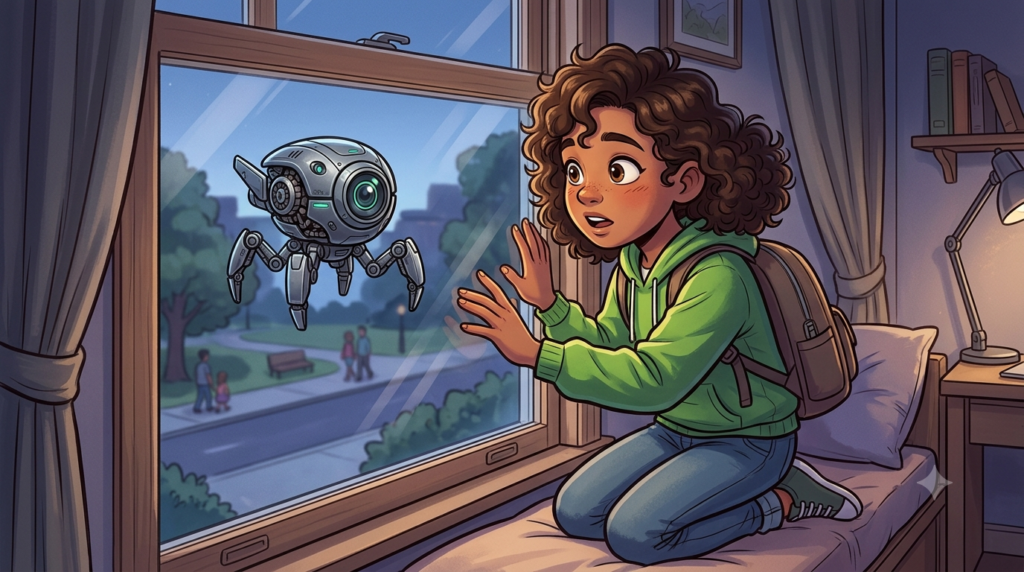
The evening had been unusually warm, the kind of warmth that made a small bedroom feel close and stuffy, and she’d pushed open her window and leaned against the sill, watching the last of the light fade purple over the rooftops of the market district. It was in that quiet, ordinary moment that she noticed something small moving against the darkening sky.
At first she thought it was a bird. Then, watching it hover and dip with an unnatural, mechanical smoothness, she thought it might be one of those little drones people used for photography, the kind she’d seen buzzing over Riverside Park during festivals. She leaned further out, curious the way any ten-year-old would be curious, trying to get a better look.
It was not a drone. Not exactly. It was longer and slimmer than any drone she’d ever seen, its body no wider than her own forearm, moving with a silence that felt, the longer she watched it, distinctly wrong.
Before she could fully make sense of what she was looking at, it changed course, and came straight for her window.
Meesha barely had time to step back before the strange little machine slipped through the gap and hovered, for one impossible second, directly above her desk — and then, in a motion too fast and too smooth to properly follow, it opened along its slender body like a mouth and simply swallowed her school bag whole, books and all, folding the whole thing away into a space no bigger than a shoebox.
She screamed. She would remember that much clearly, later — the sound tearing out of her before she’d even decided to make it. And then a strange, spreading cold moved through her, starting at her fingertips and rushing inward, and the room tilted sideways, and everything went dark.
……………………………
When Meesha opened her eyes again, the first thing she registered was the sky.
It was pale, morning-colored, streaked with thin cloud, and her neck ached fiercely from whatever position she’d been lying in. Her mouth was dry as paper. Her stomach twisted with a hunger sharper than any she’d ever felt. It took her a long, disoriented minute of blinking up at that unfamiliar sky before she found the strength to push herself upright, and a longer minute still before the world around her stopped tilting enough to actually look at.
She was outdoors, in some kind of scrubby, deserted stretch of land she didn’t recognize, though she could hear, somewhere off to her left, the unmistakable sound of water moving — the slow, thrashing rhythm of a river working its way over stones.
Meesha was, by nature, a fairly ordinary girl. She had never imagined herself in a situation like this, had never once pictured her own life containing a moment where she woke up alone in an unfamiliar field with no memory of how she’d gotten there. And yet, strangely, she found that she was not as frightened as she might have expected to be. Somewhere underneath the fear was something steadier — a kind of clear, practical focus that surprised even her.
She thought of her parents. Of Rose, of home, of school, of the small, ordinary comfort of her own bed. But mostly, turning it over and over as she picked herself up out of the flattened grass, she thought about the fact that something had gone very badly wrong here — and that whatever it was, she might well be the only person alive who had seen it happen.
She walked. There was nothing else to do. She followed the sound of the river until the scrubland gave way to open fields, where she spotted, with a rush of relief so strong it nearly buckled her knees, a handful of farmers working among the rows, calling to one another in ordinary, unremarkable voices. She kept close enough to feel less alone but far enough to stay unseen, until the fields eventually led her, tired and thirsty and footsore, to a small railway station at the edge of what she slowly, gratefully realized was still her own city — just a part of it she’d never had reason to visit before.
She had no money. Not a single coin. She stood at the edge of the platform for a long time, watching people come and go, trying to decide the one question that mattered more than any other: whether to tell someone what had happened to her, and if so, who.
It was one thing to wonder whether anyone would believe her. It was another thing entirely to wonder whether the people who had done this to her — whoever, whatever, they were — might still be watching to see if she talked. So she stayed where she was, tucked into the shadow of the station’s old ticket office, hungry and thirsty and unwilling, for now, to take a single step further than she had to. She was close to home. She could feel it, somehow, in the shape of the streets beyond the platform, in the distant, familiar smell of the market district on the wind. But close was not the same as safe, and some careful, steady part of her insisted on waiting, just a little longer, until she understood a great deal more than she currently did.
……………
Back in Solhaven, the night had turned into something far larger than anyone in either family had expected.
Rose had said nothing to the police at first — not about Corvin, not about the equations, not about the fire that had burned the wrong colors in her own back garden. She’d learned, the last time she’d tried, exactly how far that kind of talk got her with tired, grown-up faces that had already decided what a ten-year-old could and couldn’t possibly know. But sitting on the front step at two in the morning, with Kyra’s arm finally around her shoulders and the whole street lit up in red and blue, something in Rose hardened into a kind of quiet, stubborn resolve.
She marched straight up to the officer taking notes at the Okafors’ kitchen table — the same tired one who’d waved her off hours earlier — and this time, she did not stumble over her words, and she did not let herself be waved off again.
“Meesha’s bag disappeared first,” she said, loud enough that both sets of parents turned to look at her. “A boy named Corvin ended up with it by ‘mistake.’ Then I found strange symbols hidden in her math book — symbols nobody else’s book had. My sister solved almost all of them. We burned the one page we couldn’t solve by accident, at a barbecue, and the fire turned green and nearly took the whole garden with it. And now Meesha is gone, the exact same way her bag went missing before her. I know how this sounds. I don’t care anymore. You need to go to Corvin’s house.”
For a long moment, nobody said anything at all.
It was Kyra, oddly enough, who broke the silence — Kyra, who had spent the entire evening trying to talk her sister out of exactly this kind of thing. “She’s telling the truth,” she said quietly. “I solved the equation myself. I watched the fire turn green with my own eyes. I don’t know what it means. But she’s right that it isn’t nothing.”
Twenty minutes later, three police cars, Meesha’s parents, the Hale family, and a visibly uneasy captain were standing outside the tall, overgrown hedge surrounding Corvin’s unusually large and unusually quiet house.
Corvin’s grandmother answered the door in her nightgown, blinking in confusion at the lights sweeping across her front garden. Corvin’s mother appeared behind her a moment later, already talking — fast, smooth, faintly rehearsed-sounding explanations about her son being asleep, about there being some misunderstanding, about how late it was and how frightened this was all making an innocent little boy.
Nobody was listening to her very closely anymore.
It was in Corvin’s own room, tucked behind a bookshelf that swung outward at a touch too smoothly to be ordinary furniture, that the search team found what they were looking for. Not a tunnel this time — nothing so far beneath the ground. Just a narrow, hidden space no larger than a closet, humming faintly in the dark.
Mounted along its far wall, screen glowing faint blue in the sudden beam of a dozen flashlights, was a massive board, its surface studded edge to edge with sensors.
*To be continued in Episode Three*