The swings behind Green Hollow Primary creaked in the late afternoon wind, and that creak was the last ordinary sound Rose Hale would remember from that Tuesday, though of course she didn’t know it yet. She only knew that she’d finally beaten Meesha at tennis for the first time in three weeks, and that the win had made her so gleeful she’d forgotten, for a whole glorious hour, to be a good sport about it.
“Best of five next time,” Meesha said, laughing, dropping her green backpack beside the swing set the way she always did — the same worn green bag with the small embroidered flower on the front pocket, stitched there years ago by her grandmother’s careful hands. “You only won because I let you.”
“You did not let me win,” Rose said, indignant, already pushing off into the air. “Say it. Say I’m better.”
“Never,” said Meesha, grinning, and swung up beside her.
They stayed later than they meant to, the way they usually did, the sky over Solhaven turning that soft gold color it always turned in the hour before dinner — the light catching on the river beyond the school fence, on the far green smudge of the forest, on the rooftops of a city that had never, in living memory, given any of its people a real reason to worry about anything much at all. It was, everyone agreed, a wonderful place to grow up. Rose’s mother taught right here, in fact, in the very same building, which meant Rose spent her mornings being both “sweetheart” at breakfast and “Miss Rose, please pay attention” during arithmetic — a state of affairs she found only slightly less humiliating than falling down in front of the whole class.
Also Read: A Gentle Lion
It was only when the streetlights flickered on that the girls finally gathered themselves to leave, and it was only then that Meesha looked down at the grass beside the swings and went very still.
“Where’s my bag?”
They searched everywhere. The classroom, empty and locked. The bushes along the fence. Under the slide, behind the bins, twice around the whole playground in the fading light until Rose’s own mother came out calling for her, wondering what on earth was taking so long. Meesha’s eyes had gone glassy by then, though she was trying hard not to show it.
“My homework’s in there,” she said quietly, on the walk home, her voice smaller than Rose had ever heard it. “My mom’s old calculator. I don’t — we don’t really have money to just buy another one.”
Rose knew this without being told, the way you know certain things about your best friend without either of you ever saying them out loud. She knew that Meesha lived above a shoe repair shop near the market district, in two small rooms she shared with her parents. She knew that Meesha’s father, a big, warm-voiced man everyone in the neighborhood called Baba Elom, spent six days a week standing outside Riverside Park with a cart he’d built himself, selling paper cones of fried chips seasoned with a spice mix so good that people crossed half the city just to buy from him — and that even so, there were weeks that stretched thin, weeks where a lost calculator was not a small thing at all.
“We’ll find it,” Rose said, squeezing her hand. “I promise.”
The school administration promised to “look into it,” which turned out to mean very little happened for two full days. It was Rose’s older sister, Kyra, who finally suggested — with the slightly superior air she got whenever she’d solved a problem faster than everyone else — that someone had probably grabbed the wrong bag by mistake, since half the school seemed to own the exact same green backpack from the exact same shop on Miller Street.
She turned out to be right. On the third day, a small boy from the year below, a quiet kid with thick glasses that Rose vaguely recognized from the bus stop, was found still carrying Meesha’s bag, having mistaken it for his own nearly identical one. His grandmother, apparently, had only just noticed that the flower stitched on the front pocket didn’t belong to her grandson at all.
The bag came back. The books were all there, a little rumpled but otherwise fine. Everyone breathed out, called it a silly accident, and moved on with the particular speed that children move on from things that turn out, in the end, not to matter.
Rose mostly forgot about it too. Mostly.
It was two days later, home sick with a mild fever and missing an assignment, that she borrowed Meesha’s math textbook to copy down the homework she’d missed — and flipped, without thinking much of it, to Exercise 7.3.
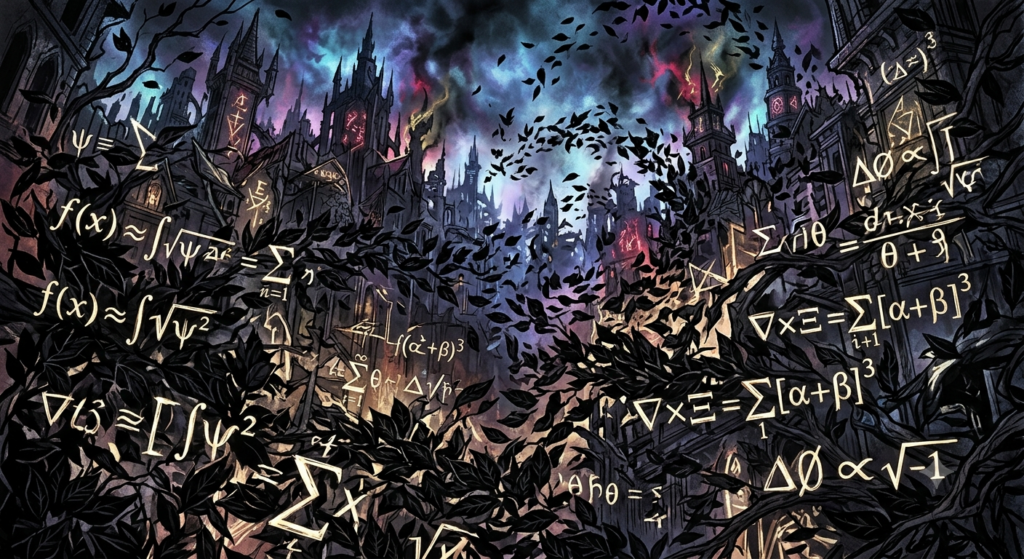
Only it wasn’t Exercise 7.3. Not really. Where there should have been ordinary fractions, or maybe long division, the kind of dull arithmetic that filled every other page of the book, there was instead a tight little block of symbols Rose had never seen before. Not numbers. Not quite letters either. Curling, angular little marks, arranged in careful rows like a code someone had gone to a great deal of trouble to write out neatly.
A Tree , A cozy Home – READ HERE
She checked the rest of the book. Every other page was completely normal. She checked her own copy of the same textbook later that evening, and Kyra’s copy too — both showed the ordinary Exercise 7.3, the one about dividing fractions, exactly as it was supposed to be.
Only Meesha’s book was different.
Rose had always been what her father fondly called “a tricky-minded kid” — the sort who read mystery novels under her blanket with a flashlight long after she was supposed to be asleep, who noticed the things other people walked straight past. So instead of saying anything to Meesha at all, she copied every symbol carefully into her own notebook that night, line for line, and returned the textbook the next morning as if nothing were unusual in the slightest.
That evening, she brought her notebook to Kyra’s room.
Kyra was twelve, two years ahead of where she was supposed to be in school, the kind of student teachers spoke about in hushed, admiring tones in the staff room — and she took one look at Rose’s careful copy of the strange symbols and immediately forgot whatever she’d been doing before.
“Where did you even find this?”
“Just tell me if you can solve it,” Rose said, which was, she knew, exactly the right way to get her sister’s full attention.
Kyra worked at it for nearly an hour, treating the marks like an unfamiliar kind of algebra, testing values, rearranging patterns, until one by one the strange symbols began giving way to ordinary numbers beneath her pencil. All of them, that is, except the very last line, which refused to balance no matter what she tried, sitting there like a locked door with no visible key.
“This one’s not solvable,” Kyra finally admitted, rubbing her eyes. “Not with anything I know, anyway.”
“Then maybe,” Rose said slowly, “it’s not the kind of math you’re supposed to know.”
Kyra gave her the look — the specific older-sister look that meant *don’t be dramatic, Rose* — but Rose barely noticed. She was already turning the puzzle over in her mind the way she turned over the pages of her favorite books, hunting for whatever clue the writer had hidden in plain sight.
Over the next several evenings, she couldn’t let it go. She photographed every symbol from her notebook onto the family computer in the study, enlarged each one until she’d memorized its every curl, and searched anything she could think to search — cryptography forums, invented-alphabet websites, puzzle groups built for exactly this sort of stubborn curiosity. Most of it led nowhere useful. Interesting, sometimes, but nowhere close to an answer.
Then, late one evening, at the very bottom of her seventeenth search — well past the point where anyone more sensible would have given up and gone to bed — she found it. A single broken-looking result, sitting at the edge of the page with no description beneath it, no image, nothing but five small grey words:
*the black leaves of yeniz*
Rose’s heart gave an odd little thump. She glanced over her shoulder at the empty study, though there was no reason to, and clicked.
The page began to load, white against the dark of her screen.
And then, cold and final:
**ERROR 404 — PAGE NOT FOUND.**
She sat back in her chair. The house was silent except for the low hum of the refrigerator two floors down, and somewhere outside, faint and far off, a dog barking at nothing.
Whatever “the black leaves of Yeniz” had once been, Rose was suddenly, completely certain of one thing: it had existed. Somebody, or something, had gone to a great deal of trouble to erase it.
And whatever it was, she thought, closing her notebook slowly, it had something to do with a missing green backpack that everyone else in the world had already forgotten about.
The library turned out to be no help at all.
Rose spent the better part of a Saturday there, hunched over the reference desk with her notebook open to the copied symbols, asking the elderly librarian, Mrs. Petrov, whether she’d ever seen anything like them in any of the old books on codes or forgotten alphabets that lined the back shelves. Mrs. Petrov peered at the page for a long time through her half-moon glasses, turned it sideways, turned it back, and finally shook her head.
“Never in forty years,” she said. “Wherever this came from, dear, it isn’t in any of my books.”
Rose tried three more sources after that — an old encyclopedia of world scripts, a university student she cornered at the market who’d once studied linguistics, even a secondhand bookshop owner who dealt in odd and unusual things. Every single one came up empty. By the following weekend, she had almost, almost, convinced herself to let it go.
And then came the barbecue.
It was Mr. Hale’s idea, as it usually was — a warm Saturday, the whole family in the back garden among the tomato vines, the smell of charcoal and lighter fluid drifting over the fence. Kyra was in charge of getting the coals going, a job she took far too seriously for someone only using a bag of charcoal and a box of matches, muttering about airflow and ignition points while Rose set the table and their mother sliced peppers in the kitchen window above them.
The coals, stubborn as they were, refused to properly catch. Kyra, growing impatient, grabbed the nearest scrap paper she could find to help feed the flame — an old, worn copybook from her desk drawer, its cover long since falling apart, pages she was certain she’d never need again. It was, though she didn’t think twice about it in the moment, the very same copybook where she’d first worked out Rose’s strange symbols, the solved equation with its one stubborn, unsolvable line still scrawled somewhere near the back.
She tore out a handful of pages and dropped them onto the coals.
For one ordinary second, nothing happened. Then the flame touched the ink of that last, unsolved line, and the whole world seemed to lurch sideways.
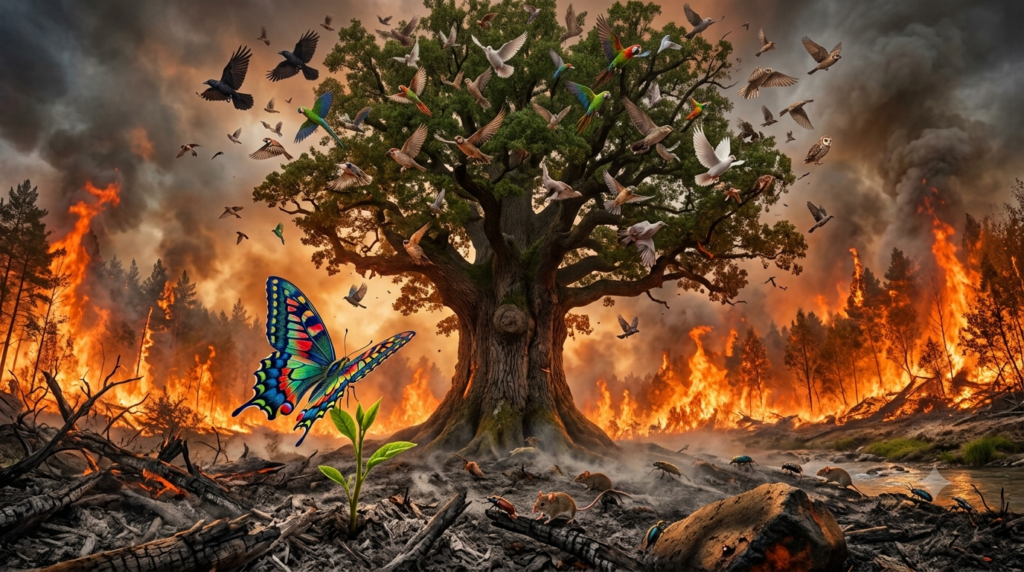
The fire didn’t simply catch. It *leapt* — a sudden, violent column of green-black flame roaring up out of the grill with a sound like tearing metal, sparks spitting outward in every direction, far past where any normal fire had any business reaching. Kyra was thrown backward off her feet. Rose screamed for her mother. Somewhere behind them, the tomato vines caught first, then the old wooden trellis, then the dry hedge along the back fence, the fire crackling and hissing in colors no ordinary barbecue fire should ever produce — sickly greens, deep purples, a black smoke that curled strangely against the wind instead of with it.
It took the neighbors, three garden hoses, and eventually two fire trucks to bring it fully under control. By the time the last ember died, half the garden lay scorched and ruined — the tomato vines gone entirely, the old oak at the fence line blackened along one whole side — though by some stroke of luck, or something else entirely, the house itself had been spared, along with, Rose noted privately, every single person in the yard.
Police came, as they always did for anything involving fire and a neighborhood full of worried questions. They asked about lighter fluid, about the type of charcoal, about whether anyone had been smoking nearby. Mr. Hale, badly shaken, could only say that the coals simply hadn’t been catching, and then, all at once, they had — too well, too strangely, too fast. In the end, the official report called it a “freak accident,” likely caused by a faulty batch of charcoal or an unnoticed gas leak from an old barbecue line. Everyone in the neighborhood repeated that explanation to each other over the following days with the particular relief of people who badly want an ordinary answer to an unordinary thing.
Rose did not believe it for one single second.
She had seen, in the half-second before the fire leapt, exactly which pages Kyra had torn free and dropped onto the coals — the same pages, she was almost entirely certain, where the last unsolvable symbol had been written out in her sister’s own careful pencil. She said nothing of this to her parents, who were already exhausted and frightened enough without her half-formed theories about strange math and stranger fires. But she thought about it constantly, turning it over at night in the dark of her room, and slowly, her attention drifted back to the one piece of this whole tangled puzzle she hadn’t fully examined yet.
The boy who had taken Meesha’s bag in the first place.
His name, she’d learned by asking around the younger grades, was Corvin. He lived three streets from the school, in a large, oddly quiet house set back behind an overgrown hedge — a house far too big, Rose thought, for a family that seemed to consist of only a boy, his grandmother, and a mother most neighbors described, in careful, lowered voices, as “a bit much” or “not quite straightforward” — a woman known for elaborate stories that never fully added up, whose husband was said to work abroad, though no one could quite say where, or in what.
Corvin himself was strange in his own quiet way. He was only in the sixth grade, small for his age, and wore glasses so thick his eyes looked twice their normal size behind them. Classmates said he slept through most of his afternoons at home and stayed up long into the night doing homework, his bedroom light visible from the street at hours no ordinary sixth grader should be awake. None of it, on its own, meant very much. But taken all together, laid out beside a missing bag, a set of symbols that shouldn’t exist, and a fire that burned the wrong colors, it sat uneasily in Rose’s stomach like a stone she couldn’t quite swallow.
Her chance to look closer came sooner than she expected.
Rose’s parents rarely left the girls home alone overnight — it simply wasn’t something they did — but when word came that Mrs. Hale’s aunt had fallen seriously ill in a town three hours outside the city, there was no question of leaving quickly. The girls were pulled from school for the day, given careful instructions, a list of numbers to call if anything at all went wrong, and left in the tall blue-shuttered house with promises to be back by the following evening.
It was that night, with the house quiet and their parents’ car long gone down Larkspur Row, that Rose finally told Kyra everything — the boy, the strange house, the timing of it all, and her plan, fully formed in her mind for days now, to sneak out after dark and watch Corvin’s house for herself.
Kyra’s reaction was immediate, and furious.
“Absolutely not !!!”
She said, standing in the middle of the kitchen with her arms crossed. “Rose, listen to yourself. You want to *spy* on a ten-year-old because his house is big and his mom talks too much? That’s not a clue, that’s just — that’s just *weird*, and it’s dangerous, and Mom and Dad trusted us to stay *here*, not go wandering around the neighborhood in the dark chasing some story you made up in your head—”
“I didn’t make it up!” Rose shot back, her voice rising to match her sister’s. “You solved that equation yourself, Kyra! You burned it, and the fire went *green*! Explain that if it’s nothing!”
“I don’t know what that was, but it doesn’t mean—”
“It means something is happening in this city that nobody wants to look at, and Meesha’s bag was the start of it, and I am not going to just sit here and—”
It was right in the middle of that sentence, both girls red-faced and breathing hard, standing three feet apart in the kitchen light, that someone began pounding on the front door.
Not knocking. Pounding.
Kyra froze. Rose froze. For one long moment, neither of them moved, and then Kyra crossed the hall in four quick strides and pulled the door open.
Meesha’s parents stood on the porch, and one look at their faces told both girls that whatever this was, it was far worse than anything either of them had imagined in the last ten minutes of arguing.
“Is she here?” Meesha’s mother asked, her voice cracking on every word, Baba Elom standing white-faced and silent behind her. “Please — is Meesha here with you? Please tell me she’s here.”
Rose’s stomach dropped straight through the kitchen floor.
“She’s not here,” Kyra said slowly. “What happened? What’s wrong?”
“She’s gone,” Meesha’s mother said, and now she was crying openly, gripping the doorframe as though it were the only thing holding her upright. “She was in her room. I heard her — I heard her not twenty minutes ago, and then I went to call her for dinner and the window was open and she is *gone*, and her school bag is gone too, and I don’t — I don’t understand, I don’t understand how a person simply *disappears* from her own bedroom—”
The rest of that night passed for Rose in fragments, disjointed and strange, the way nightmares feel the next morning. Police cars pulling up outside the Okafors’ small rooms above the shoe shop, red and blue light sweeping across the walls. Officers moving through Meesha’s tiny bedroom with flashlights, finding the window latch undamaged, no footprints in the flowerbed below, no sign that anyone had climbed in or out at all — only an empty bed, still warm, and an open window looking out over a perfectly ordinary street.
Rose tried, twice, to tell someone — anyone — about the symbols, the fire, the strange green flame, the boy named Corvin with his too-big house and his too-late homework. She told Meesha’s parents first, the words tumbling out too fast and too tangled to properly follow, and watched their exhausted, terrified faces go politely, gently blank, the way grown-up faces go blank when a child says something they don’t have room in their hearts to consider right now. She tried the police next, a tired-looking officer taking notes by the Okafors’ kitchen table, who wrote down perhaps three words of what she said before moving on to ask Meesha’s mother, again, whether there had been any strangers near the building lately.
Nobody had a single clue. Not the police, not the neighbors woken by the commotion, not Baba Elom, who stood outside his own front door long after midnight simply staring up at his daughter’s empty window as though staring hard enough might make her reappear in it.
Kyra found Rose sitting on the Hales’ front step near two in the morning, knees pulled up to her chest, staring down the dark street toward Corvin’s quiet, oversized house.
She didn’t say *I told you so*, and Rose didn’t say *I was right*, though both thoughts hung heavy and unspoken in the cold night air between them.
Instead, Kyra sat down beside her sister on the step, wrapped an arm around her shoulders, and for the first time since the whole strange business had begun, said only:
“Okay. Tell me everything again. From the very start.”
*To be continued in Episode Two.* COMING SOON