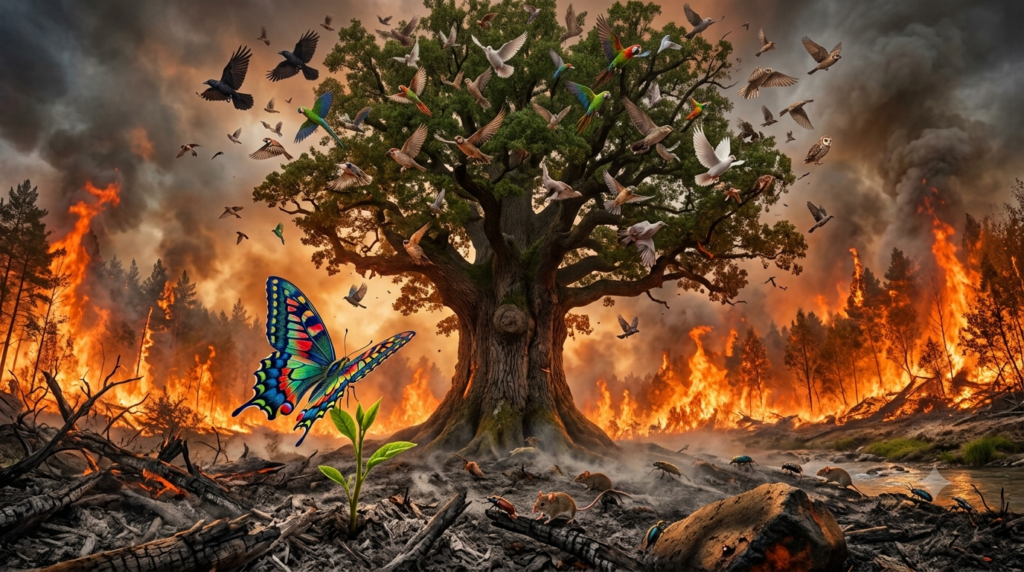
This story is sequel of In The Shade Of Cedric – the Great Oak story. Read that interesting story to get an idea of how a miniuniverse was survived by a forest fire and who was Iris.
A year had passed since the fire, and the hillside had mostly forgotten it.
New leaves had grown back thick and green over Cedric’s blackened side. Grass had returned to the burnt slope below. Even the deep crack near his roots — the one that had once hidden a broken butterfly — had closed over, leaving only a faint dark seam in the bark, like an old scar that had stopped aching.
Life, in most ways, had gone back to normal.
Except for one thing.
“MINE. That’s MY branch, Ben, go find your own—”
“It was OUR branch first, Didy, you don’t just get to—”
“I’ve sat here since SUNRISE—”
“That’s not how branches WORK—”
Cedric sighed, the way old trees sigh, which is mostly just a longer pause between one gust of wind and the next. “It has been like this,” he murmured to Bartholomew, “for six months now.”
Bartholomew, half-asleep in his hollow, didn’t open his eyes. “Since Marigold left.”
“Since Marigold left,” Cedric agreed.
She had flown off one grey morning, saying only that she needed rest, that her four remaining chicks were old enough now to manage without her — and she had simply never come back. Nobody in the tree said much about it anymore. There was a fifth chick, too, that nobody mentioned at all — little Cozy, who had caught a chill in his first spring and never gotten strong enough to shake it. Marigold had never quite been the same after that. Perhaps that was why she’d left. Nobody knew for certain, and by now, nobody dared ask.
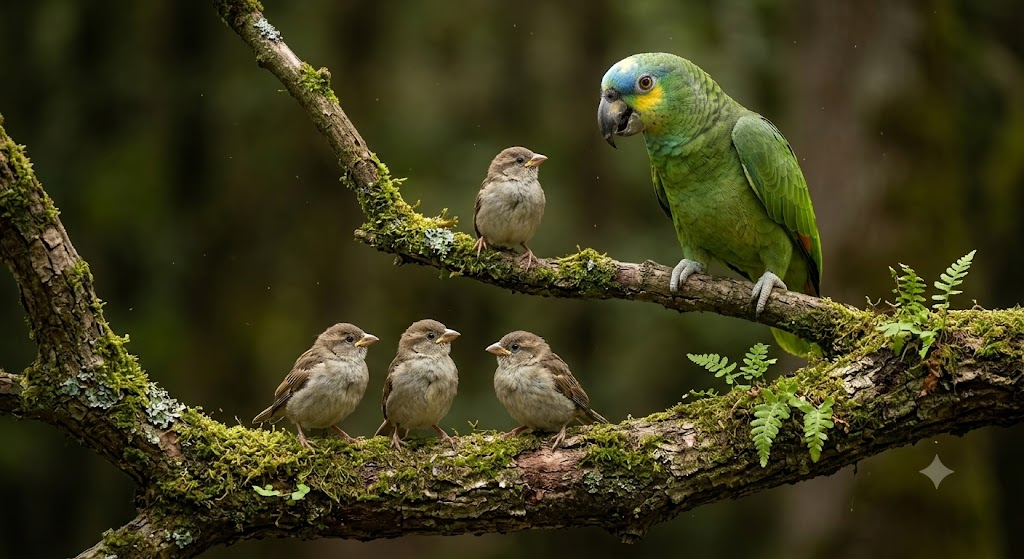
What was left were four chicks, nearly grown, and entirely unsupervised: Jen, Ben, Pup — and Didy, who slept alone, two branches down from the other three, because none of them wanted her any closer.
“She thinks she’s better than us,” Ben muttered, not quietly enough, as Didy passed below them one morning on her way to the parrot’s branch.
“She’s not better than us,” Jen said. “She’s just loud about being better than us.”
“I can HEAR you,” Didy called back, without turning around.
“GOOD,” said Pup, the youngest, who mostly just repeated whatever his older siblings said with extra enthusiasm.
Didy didn’t answer. She kept flying, straight to the sunniest branch, where Pico the parrot was, as usual, upside down.
“Rough morning?” Pico asked, not bothering to right himself.
“The usual morning.”
“Sit. Eat. Ignore them.” He nudged a beakful of berries toward her without further comment, the way he did most mornings now — because somewhere in the last six months, without either of them quite planning it, the sunny branch had become the one place Didy’s siblings didn’t follow her, mostly because Pico had made it extremely clear, loudly and often, that he would not tolerate it.
“You’re too dominant for your own good, you know,” he told her once, through a mouthful of berries. “That’s why they don’t like sitting with you.”
“I’m not dominant. I just know what I think.”
“Same thing, from a sparrow three days younger than you.”
“I’m not younger than them, we hatched the same—”
“Doesn’t matter. You act older. Older siblings get resented. It’s practically a law of nature.” He said it lightly, the way he said most things, but he always made sure, after, to glance down the branch to be sure Jen and Ben weren’t drifting any closer than they should.
It got worse before it got better.
Three weeks later, Jen and Ben cornered Didy on the lowest branch while Pico was off chasing a moth, and this time there was no lightness in it at all.
“You know why Mom left, don’t you,” Jen said.
Didy went very still. “Don’t.”
“I’m just saying. Cozy got sick, and you were the one who was supposed to be watching him that afternoon, and then Mom couldn’t even look at any of us right afterward, and then she—”
“That is not what happened.” Didy’s voice cracked, high and furious. “I was FOUR DAYS OLD, Jen, none of us could watch ANYONE—”
“I’m just saying what everyone’s thinking—”
“Nobody is thinking that except YOU—”
“ENOUGH.” Bartholomew’s voice cut down from the hollow, low and sharp enough that even Ben flinched. “Both of you. Now.”
They scattered, but the words didn’t. Didy sat alone on the lowest branch long after they’d gone, and did not go find Pico that afternoon at all, and Cedric, watching quietly from above, thought — not for the first time — that grief has a terrible way of finding somewhere new to land when the person who caused it isn’t there to hold it anymore.
It was Pico himself who fell ill, not long after — and it was Didy who found him.
She landed on the sunny branch one morning expecting the usual greeting, and instead found him hunched small against the bark, feathers puffed out wrong, eyes half-closed.
“Pico?”
“M’fine,” he mumbled, not opening his eyes properly.
He was very clearly not fine. His breathing came ragged, and when she pressed close against his side the way she’d seen Marigold do for sick chicks once, long ago, his whole body was burning hot.
“PICO.” She was already shouting toward the hollow before she’d finished the word. “BARTHOLOMEW! Something’s wrong with Pico!”
Bartholomew came at once, old wings moving faster than they had in months, and pressed one wingtip gently to the parrot’s chest, listening.
“Infection,” he said finally, grim. “Deep in the lungs, by the sound of it. I’ve seen it before. It doesn’t always end well.”
“Then we FIX it,” Didy said. “Tell me how.”
“I don’t know how, Didy. I only know what it is.“
She went to the dove next, who had grown into a calm, steady bird over the past year, well known for her patience with sick and frightened things.
“There are herbs,” the dove said slowly, “that ease the fever. I can find those. But easing a fever isn’t curing what’s underneath it.”
She went to Henry, the old cuckoo who lived three trees down and claimed, loudly and often, to remember things “from before any of you were even eggs.”
“Ah,” Henry said, tilting his head with great importance. “Yes. I have heard of a cure for this. Somewhere. I believe. Give me a moment, it’s — it’s on the tip of my — no, it’s gone. Try the squirrel.”
The squirrel, when Didy found her, was far more useful, though far less dramatic about it.
“There’s a wine,” the squirrel said, cheeks full of acorns, “at the mouth of the big cave, past the waterfall. Made from berries that only grow right there, in the spray. My grandmother swore by it for chest fevers. I’ve never had it myself. It’s a long way.”
“How far?”
“A few kilometers. Maybe more.”
The dove’s herbs helped, a little, the very first day — Pico’s breathing eased, and he managed, weakly, one joke about Bartholomew’s “bedside manner” before falling back asleep. But by the second day, the fever crept back up regardless, and Didy understood, with a cold certainty, that herbs alone would not be enough.
She flew for the cave the very next morning, before anyone could tell her not to.
It took most of the day to find it — a waterfall thundering white over black rock, and at its base, a shallow cave mouth thick with the smell of ripe, dark berries the squirrel had called emberberries, fermenting slowly in the damp stone hollow into something the local creatures simply called Emberberry Wine.
Didy had just landed on the cave’s lip, wings aching, when she saw the snakes.
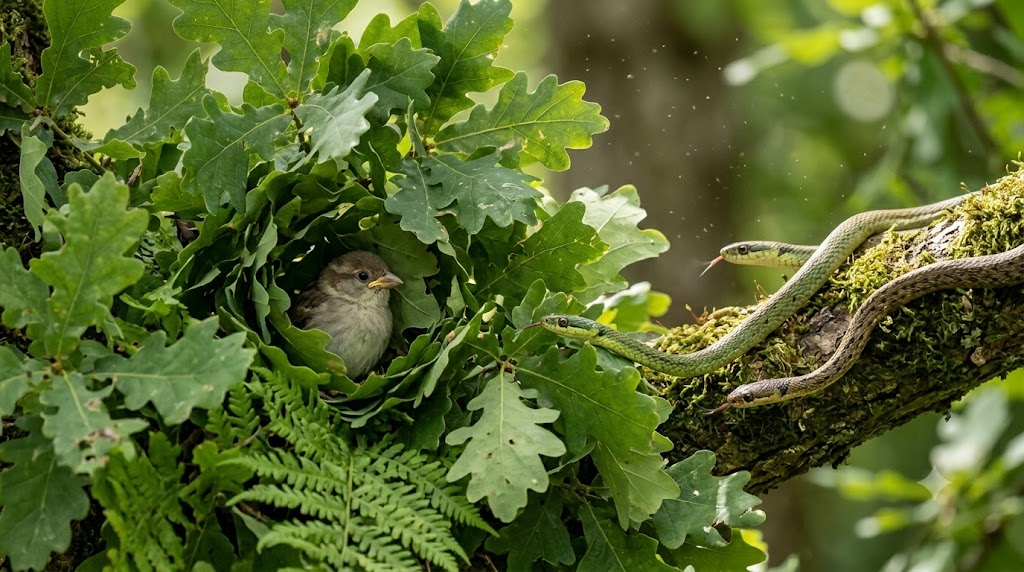
There were more of them than she expected — a whole loose colony, coiled in the warm damp near the water — and one, larger than the rest, uncoiled the moment Didy’s shadow crossed the cave floor.
“Little bird,” the snake said, low and pleased, “you’ve flown a long way to be dinner.”
Didy didn’t wait to answer. She threw herself sideways into a tangle of wet ferns growing along the cave wall, and the snake struck exactly where she’d been a half-second before, jaws snapping shut on empty air.
“Where—” the snake hissed, twisting, searching the ferns.
Didy pressed herself flat, wings tucked, heart hammering so hard she was certain it would give her away — and then, from somewhere above her, something small and pale drifted down and settled directly onto the fern beside her head.
Iris.
The moment she landed, the whole cluster of leaves around Didy shifted color — deep mottled green sliding into a dappled brown-and-shadow pattern, exactly the color of wet stone and old leaf-litter, exactly the color, by pure luck or something more than luck, of the cave floor itself.
The snake’s head swayed over the ferns twice, three times, tongue flicking — and found nothing but ordinary shadow where a small brown bird should have been.
“Gone,” the snake muttered, disgusted, and slid back toward the water.
Didy didn’t move again until Iris lifted away, the color fading back to green behind her, and didn’t breathe properly until she was a full kilometer from the cave, wings burning, empty-beaked, with not one drop of Emberberry Wine to show for the whole terrifying day.
She told Pico everything that evening, expecting relief that she was alive. She did not expect what she actually got.
“You did WHAT?” Weak as he was, propped against the bark with his eyes still fever-glassy, Pico’s voice cracked through the whole branch like a whip. “You flew there ALONE? Past a SNAKE COLONY? For ME?”
“It doesn’t matter, I didn’t get hurt, Iris—”
“It matters ENORMOUSLY. You are NOT going back there. Do you hear me? I would rather have this fever for the rest of my miserable life than have you go anywhere near that cave again.”
“Pico—”
“I mean it, Didy.” His voice broke on it, not with anger now but something closer to fear. “I’ve already lost Marigold. I’ve already watched this tree lose too many people it loved. I am not adding you to that list. Promise me.”
She didn’t promise. But she didn’t argue either, and for once, that silence was answer enough for both of them.
That night turned bitterly cold, rain hammering down through branches that had only just begun to trust the sky again since the fire, and by morning, Pico’s fever had climbed back higher than it had ever been.
He barely stirred when Didy pressed against his side. His breathing rattled, deep and wrong, and Bartholomew, checking him with grim, careful wings, would not meet anyone’s eyes when he finished.
“I don’t know how much longer,” he said quietly, “his body can fight this alone.”
The whole tree gathered that morning without anyone quite deciding to — Bartholomew, the dove, Henry the cuckoo wringing his wings uselessly, even a few finches who barely knew Pico at all but couldn’t bear to stay away. Didy sat pressed against him, too frightened even to cry properly, whispering the same useless thing over and over.
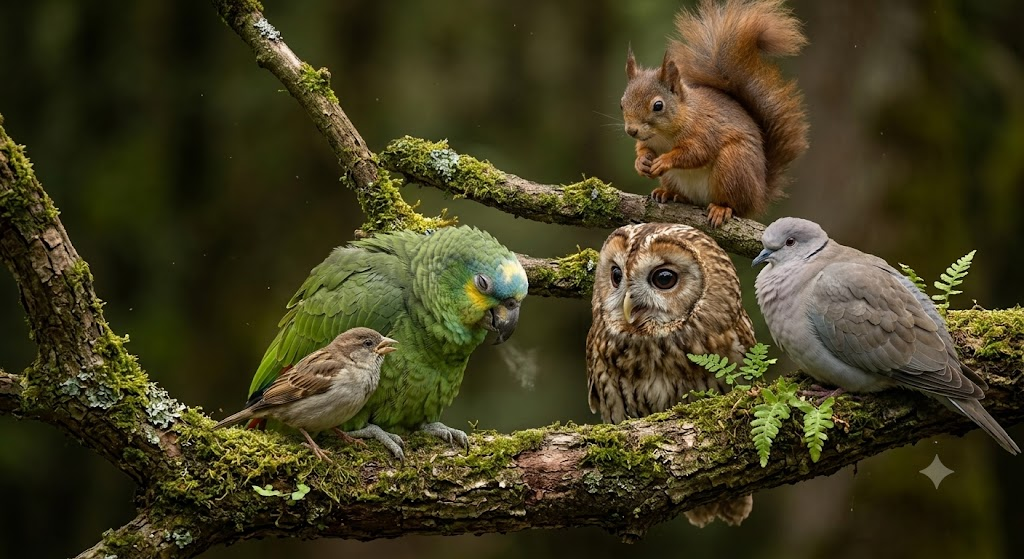
“Don’t you dare. Don’t you dare, Pico, not after everything—”
And then, from below, three small, exhausted, unmistakable shapes came beating hard through the rain toward the branch — wings soaked through, beaks stuffed nearly to bursting with small dark bundles of leaves.
Jen. Ben. Pup.
“MOVE,” Jen gasped, barely able to speak around what she was carrying. “Move, let us THROUGH—”
They dropped their bundles at once, unwrapping soaked leaves to reveal small, dark, unmistakably sticky clusters — berries crushed and fermented, the whole rich smell of Emberberry Wine flooding out into the cold morning air.
Didy stared at them, speechless.
“We heard,” Ben said, breathing hard, still trembling from the flight, “what happened at the cave. We heard about the snakes. We weren’t going to let you go back there alone again — so we went. All three of us. Together.”
“You HATE me,” Didy said, the words coming out before she could stop them.
“We don’t hate you,” Pup said, small and fierce, still catching his breath. “We’re horrible to you. That’s different.”
Jen looked away, embarrassed, but didn’t take it back. “We were horrible,” she admitted quietly. “We’re sorry. Can we please just — help him first, and be sorry after?”
Bartholomew didn’t wait for anyone’s permission. He worked quickly, dipping soaked feathers into the crushed berries and pressing it, drop by careful drop, past Pico’s cracked beak, while the dove murmured something low and steady the whole time, the way she always did for frightened, fevered things.
For a long, terrible hour, nothing changed at all.
And then, slowly, Pico’s ragged breathing began to even out. His feathers, puffed tight with fever, loosened, just slightly. His eyes, when they finally opened, were clearer than they’d been in two days.
“Did I die,” he croaked, “and end up somewhere with FOUR sparrows arguing over my body? Because that seems like a cruel afterlife.”
Didy laughed, and it came out half a sob, and she pressed her head against his side without any of her usual dignity at all.
“You’re not dying,” she said. “You’re just annoying. As always.”
“Comforting,” Pico murmured, and closed his eyes again — but this time, everyone could see, it was only sleep.
Jen, Ben, and Pup stayed on that branch the whole rest of the day, closer to Didy than they had sat in six months, none of them quite finding the words for everything that needed saying yet — but none of them leaving, either.
Cedric, high above them all, felt the rain finally ease, and the wind stir gently through his branches, and swayed to it, slow and quiet, the way he always did when something in his tree had, at last, begun to mend.
#storyforkids #storyforchildrens #serials #fiction