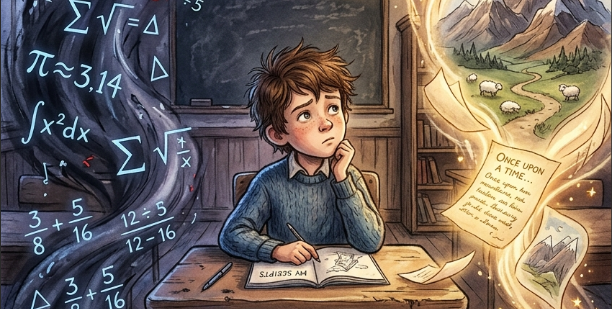
The classroom smelled of chalk dust and the ghost of yesterday’s rain. Outside, the afternoon sun slanted low through the window bars, throwing long gold stripes across the desks, and somewhere beyond the wall, a crow was complaining to no one in particular.
Mr. James sat beside Oliver, his big frame folded carefully onto the small wooden bench, like a man trying to make himself smaller so as not to frighten a bird. He was thirty-five years old, with kind, tired eyes and a voice that never once, in all the months he had taught Grade Four, risen in anger. He tapped his pencil gently against the open notebook.
“Now, Oliver. Look here. If the tractor carries fifteen sacks in one trip, and it makes four trips a day…” He paused, waiting. “How many sacks does it carry altogether?”
Oliver looked at the numbers. They sat on the page like little black insects, unmoving, refusing to mean anything. He knew, somewhere far away, that there was an answer. He knew other boys — Grade Four boys no older than him — would already have scratched it out and moved to the next line. But for Oliver, the numbers simply would not become a tractor. They would not become sacks. They stayed numbers, cold and flat, and his mind kept sliding off them the way rain slides off a tin roof.
“Fifteen… times four?” Oliver mumbled.
“Good — and what is fifteen times four?”
Oliver’s mouth opened. Nothing came.
Mr. James did not sigh. He never sighed at Oliver, not once, though Oliver sometimes wished he would — at least then it would feel like an ordinary failure, the kind other boys understood. Instead the teacher simply began again, slower, breaking the number into pieces the way a mother breaks bread for a child too young for a whole loaf.
But Oliver was not really there anymore.
Through the open window behind Mr. James’s shoulder, in the strip of playground where the little ones went for their break, Miss Carter — the nursery teacher, round-faced and quick-tempered — was talking to another teacher in a voice that was trying very hard to be a whisper and failing.
“…and she took the good wardrobe, mind you, the one that was Mother’s, and didn’t even ask—”
“Your own sister?”
“Don’t get me started, don’t get me started—”
The words drifted in and out like a radio not quite tuned, and Oliver — without meaning to, without even deciding to — began to build a house around them. He did not hear “wardrobe.” He heard a locked wooden chest, brass-cornered, groaning as it was dragged across a floor at midnight by a sister with a candle and a guilty face. He gave the sister a name — Clara, because the word had sounded like a name to him — and a reason: not greed, but a secret debt, a promise made to someone in trouble, something noble hidden inside something that looked like theft. In his head, a whole small war unfolded between two sisters and a wooden chest, complete with a rainy road and a horse that did not want to be led.
He did not notice that his pencil had stopped moving entirely.
“Oliver.” Mr. James’s voice was patient as a held breath. “Where have you gone?”
Oliver blinked, and the wooden chest and the candle and the horse all folded themselves away like a paper fan. “Sorry, sir,” he said, and looked back down at the insects on the page, and once again could not tell what they wanted from him.
They worked through it together — Mr. James drawing little groups of dots, four groups of fifteen, counting them out loud so patiently that a lesser man’s voice would have cracked with the tenth repetition — until at last, more from Mr. James’s counting than Oliver’s own understanding, the number sixty appeared at the bottom of the page in Oliver’s careful, too-neat handwriting.
“There,” Mr. James said, and smiled the way tired people smile when they mean it anyway. “That is enough for today.”
Oliver closed his notebook softly, as though it might wake something sleeping inside it. “Thank you, sir,” he said, and meant it more than the words could show, and gathered his bag, and went out into the corridor where the afternoon light lay in long gold bars across the floor.
At the gate, Mr. Turner was waiting, leaning against his bicycle with the particular patience of a man who has waited at this gate many afternoons before. He ran the small shop two streets from their house, and on days their parents were still at work, it fell to him to walk the boys home.
“Where’s the champion?” Mr. Turner asked, straightening. He always called Harry that, half in fondness, half in the way people speak of things they are slightly in awe of.
“I don’t know,” Oliver said. “He should have come by now.”
They looked around the thinning schoolyard — a few boys still dawdling by the tap, a ball rolling untended near the wall — but no Harry.
“When I passed your house,” Mr. Turner said, frowning, “the gate was locked.”
“Maybe he’s already home,” Oliver offered. “That’s the only thing that makes sense.”
But before they could decide anything, a small boy from Grade Three came pelting up, breathless, pointing back the way he’d come. “Harry’s playing with Emily — by the street with the big tree!”
“Emily?” Mr. Turner’s eyebrows drew together like two clouds about to argue. Emily was his own daughter, six years old, whom he had left an hour ago at the shop under the sleepy watch of the sales girl, with strict instructions to sit quietly and thread beads. Everyone, including her own father most days, simply called her Minion — for the way she toddled around bossing people twice her size, exactly like the small yellow creatures in the film she’d watched forty times.
They found her exactly where the boy had said — barefoot on the packed dirt beneath the old oak tree, blowing soap bubbles from a little plastic wand, utterly delighted with herself, while high above her, Harry balanced along a thick branch, laughing as he swiped at the bubbles before they could pop.
“Catch that one! No — the fat one, Harry, the fat one!” Minion shrieked, stamping her foot.
Harry dropped from the branch with the easy, unthinking grace of a boy who had never once worried about falling, landed, dusted his palms, and grinned at them all.
“You were meant to be at the gate,” Oliver said quietly.
“I know, I know.” Harry ruffled Oliver’s hair on the way past, already half-forgiven by everyone except Oliver himself. “Come on, then.”
They walked home together — Mr. Turner wheeling his bicycle, Minion swinging between the two brothers’ hands, chattering about bubbles and a caterpillar she had named — and Oliver walked a little behind them all, watching his brother’s back, the loose, unbothered way Harry moved through the world, as though every door in it had already agreed to open for him.
He always plays. He always enjoys himself. And still he scores better than me, Oliver thought, while I sit and study and only fall further behind.
He said nothing. He never did. But the thought settled into him quietly, the way a stone settles into soft mud — not sinking all at once, but a little deeper every time it was stepped on.
That Sunday, Oliver went with his dad to restock the shop.
His dad was a simple man, honest in the way poor men often are — not from lack of temptation, but because a single lie, once discovered, could cost him a customer he could not afford to lose. He sold fruit at a modest stall in the market, and though the money was never much, it was always enough — enough for rent, enough for school fees, enough for the small, careful dinners his wife cooked at home between her long shifts as a cook in a nearby restaurant kitchen.
Oliver loved this market the way other boys loved cricket grounds. He had once written two stories about it, in a notebook no teacher had ever asked to see. One was about a tractor driver named Sam, whose old, rusted tractor one day simply refused to be ordinary any longer, growing wings of dented tin to fly grain sacks to villages that had none. The other — his favorite — was about a magician who lived, unseen, among the fruit stalls, invisible to everyone, eating whatever he pleased while shopkeepers counted their mangoes each evening and blamed one another for the shortfall, never once suspecting the small, grinning thief who sat cross-legged on the awning above their heads.
No teacher had graded those stories. No exam had asked for them. Yet Oliver could recite whole scenes by heart, the way other boys recited times tables he himself could never hold onto.
Now, walking beside his dad between the stalls, Oliver let his mind drift again, into awnings that might hide invisible magicians, into carts that might, if no one was watching closely enough, decide to grow wings of their own.
That night, after the dishes were washed and the lamp turned low, Oliver took out his old, soft-cornered notebook and began to make a list.
He wrote down every subject, and beside each, tried to remember how many hours he had given it that week. Then his marks. 45, 60, 34, 65
Then, on the opposite page, he began a second list — Harry’s. He didn’t have Harry’s real hours, but he had watched enough evenings to guess: games on the tablet until Mom called twice for dinner; chess with old men outside the shop who always seemed delighted to lose to a thirteen-year-old; painting left half-finished on the windowsill because he’d grown bored and wandered off. And beside all that, glimpsed once by accident in Harry’s own notebook: 85, 79, 89, 95
Oliver closed the notebook gently, the way you close a door on a room you don’t want anyone to know you’ve been standing in.
It isn’t fair, he thought, and the thought was not loud. It was small, and quiet, and it settled into the same place where all his other thoughts had been settling for months, packing down a little tighter each time, like snow that never melts between one fall and the next.
“Another test failed,” his dad said one evening, not shouting — he never shouted — but in the low, tired voice of a man doing sums of his own: rent, and fees, and the fruit that had spoiled that week before it could be sold. “Oliver. I sell fruit twelve hours a day so you can sit in a classroom. What is so hard about sitting in a classroom?”
His mom, still in her kitchen apron, replied instead of him “Not every child’s mind runs the same road.”
“Then which road does his mind run?” his dad asked, tired enough that the question came out sounding like an accusation, though he had not meant it as one.
Oliver said nothing. He thought of the tractor with tin wings, and knew there was no way to explain that this was the road his mind ran, because no one had ever asked him to walk down it in a classroom, and so no one had ever seen it was a road at all.
He went to bed without dinner that night, not because he was forbidden it, but because his throat had closed too tight to swallow.
It started, of all things, with a crown made of leaves.
Minion had appointed herself Queen of the Street that afternoon — a title she awarded herself roughly twice a week — and had decided that Oliver, walking home slower than the others, was to be her royal advisor.
“Kneel,” she ordered, holding out a lopsided circlet of woven leaves and one bent bottle cap that she insisted was a jewel.
“I’m not kneeling on the road, Minion.”
“It’s not Minion. It’s Your Majesty.” She stamped one small sandal for emphasis. “And you have to kneel or the kingdom will fall.”
“What kingdom?”
“This one.” She swept an arm grandly at the empty lane, three stray chickens, and Mr. Turner’s shuttered shop. “Now kneel, Advisor Oliver, and I shall knight you.”
Sighing theatrically, Oliver dropped to one knee on the dusty road while Minion tapped him extremely hard on each shoulder with a stick that had definitely been a fence post in a previous life.
“Ow — that’s my shoulder, not a drum—”
“Silence! By the power vested in me, Queen Minion the First, I hereby knight you Sir Oliver of Not Doing His Homework.”
Oliver’s head came up so fast the leaf crown nearly fell off. “Who told you that?”
“Nobody told me anything,” Minion said, with the wide, wounded innocence of a six-year-old who has clearly overheard everything. “I just know things. I’m the Queen.”
“You’re a menace is what you are.”
“A menace and a Queen,” she agreed happily, entirely unbothered, and then, with no transition whatsoever, seized his hand and towed him toward the ditch beside the road. “Come on, Sir Oliver, there’s a frog here as big as my foot, I named him Kevin, you have to meet him—”
By the time they reached the gate, Oliver was laughing despite himself, muddy to the elbow from an unsuccessful attempt to catch a frog named Kevin who very much did not wish to be caught, the ridiculous leaf crown still crooked on his head because Minion refused to let him take it off “until the ceremony was officially over,” whatever that meant. It was, for perhaps twenty whole minutes, the lightest his chest had felt in weeks.
Then he stepped through the gate, and the evening waiting for him inside was not light at all.
Their parents were both late that night — his mom’s shift stretched by a large party booking at the restaurant, his dad still totaling the day’s sales after a delivery truck had come hours behind schedule. The house was theirs alone, just the two brothers, the way it sometimes was.
Harry had come home from a school chess match flushed and triumphant, still turning his little brass trophy over in his hands, and it was in that mood — bright, careless, entirely unaware of where the evening was about to go — that he spotted Oliver’s practice math sheet lying open on the table, a fat red 38% circled at the top.
“Ohh, Oliver.” He picked it up, grinning, meaning, in his own thoughtless way, only to tease the way he always teased. “Thirty-eight? Mate, my chess club’s five-year-olds could—”
“Put it down.”
“I’m just saying—” Harry held the sheet a little higher, out of easy reach, still grinning, still not seeing anything wrong in it at all. “Did the numbers finally learn to sit still for you, or—”
“Give it back.” Oliver’s voice cracked, too loud for the quiet house, and he lunged for the sheet.
“Whoa — okay, okay, here—” Harry, startled by how suddenly serious this had gotten, took a step back toward the stairs, still half laughing, still not understanding, the paper held just out of reach. “It’s just a joke, calm down—”
“I’m sick of it being a joke to you! Everything’s a joke to you, everything’s easy for you—”
“That’s not — Oliver, it’s just marks, why are you—”
Oliver shoved him. He didn’t decide to. His hands simply moved, hard, into his brother’s chest, and Harry — one foot already on the bottom stair, off balance, still holding a trophy in one hand and a sheet of paper in the other, with nothing free to catch himself with — went backward.
There was a sound of feet failing to find the step. There was Harry’s arm flailing for the banister and missing it by an inch. There was the sickening, ordinary thud-thud-thud of a body meeting stairs the wrong way, and then a final, harder crack as his head met the metal foot of the railing at the bottom.
And then there was nothing at all. Just Harry, still, on the floor, and the little brass trophy rolling in a slow circle beside his open hand.
“Harry?” Oliver’s voice came out as almost nothing. “Harry — Harry, get up — this isn’t — get up—”
Harry did not get up.
Oliver stood frozen at the top of the stairs, his whole body roaring with a silence louder than any sound, staring down at his brother, at the dark line already spreading slowly from beneath his head — and it was in that exact moment that he heard it: the unmistakable rattle of a key in the front door.
His parents were home.
Later, Oliver would not be able to explain, even to himself, what happened in the three seconds between hearing that key and finding himself already moving. He knew only that the thought of his father’s face, arriving to find him standing over Harry like that, was a thing he could not survive standing still for — and so, as the front door creaked open and his mother’s tired voice called out “we’re home, boys—”, Oliver was already gone, out through the kitchen, out the back door into the dark yard, running, without a plan, without a destination, without once looking back at the brother he had left broken on the floor behind him.
Harry lived. It took two months in a hospital bed to prove it, and much longer than that to prove it to himself.
He came home a different boy. There was a small, permanent dent above his left temple, hidden mostly by his hair, and headaches that arrived without warning, like weather rolling in off a mountain he could not see. But the visible wound healed faster than the one nobody could see at all.
For a long time, Harry was simply, ferociously angry — the kind of anger that has nowhere safe to land, and so lands everywhere. He shouted at teachers who had done nothing but ask if he was feeling better. He refused, some mornings, to put on his school uniform at all, sitting instead on the floor of his room with his back against the door, arms crossed, silent as a locked box, until his mom’s pleading through the wood turned first to tears and then, exhausted, to silence of her own. He said cruel things to his dad that he did not, underneath, mean — you always liked him better, you never once asked what he took from me — words that came out of him like something poisoned finally being lanced. He told the doctor, once, in a flat, cold voice that frightened even himself, exactly what he would do if Oliver ever came back: find him, and hurt him the way Oliver had hurt him, and see how he liked being the one left broken.
The doctor did not scold him for saying it. He only asked, gently, “And after that. What then?” and Harry had no answer, because he had never once let his imagination walk past the hurting to see what waited on the other side of it.
It was on one of the worst afternoons — a headache pressing behind his eyes like a fist, his mom’s careful, worried hovering scraping at nerves already raw — that Minion came bouncing up the lane the way she always did, six years old and utterly without radar for other people’s pain.
“Harry! Harry, guess what — I heard your mom say you cry like a baby at night, is it true, do you cry like a—”
She meant nothing by it. She was six. She had heard something half-understood through a wall, the way children do, and turned it, as children do, into a joke to offer like a gift.
But something in Harry, stretched thin as old rope for months, snapped all at once. His hand was already moving before he had decided anything at all — rising, fast, aimed — and Minion’s small face had just begun to crumple in surprise when his own hand stopped, hanging in the air a bare few inches from her, trembling.
He stood there, frozen, staring at his own raised palm as though it belonged to a stranger.
Minion did not laugh now. She stood very still, wide-eyed, waiting to see what he would do, one small hand already creeping toward her mouth.
Harry lowered his arm slowly, as if it weighed a hundred pounds, and sat down hard on the step behind him, and put both hands over his face.
What am I becoming, he thought, and the thought terrified him more than any headache had. I was about to hit a six-year-old for a joke she doesn’t even understand. I have spent months hating my brother for the very thing I almost just did myself.
He did not shout at anyone else after that day. He did not, all at once, become calm — grief and rage do not leave a person on command, the way a light does not stop being hot the moment you decide to stop touching it. But he began, slowly, to ask his doctor different questions. Not how do I find him or how do I make him pay, but why did I almost do that, and what is happening inside me, and, eventually, turned toward books instead of fists — reading, with a hunger that surprised even him, about how minds could break under pressure and bend under grief, about attention and anxiety and the slow architecture of a family under strain. He began, for the first time, to wonder what exactly had been happening inside Oliver, all those years, that no one — least of all Harry — had ever thought to ask.
Oliver’s road out of that house was not a story. It was hunger, first — real, gnawing hunger, the kind that makes a ten-year-old’s hands shake — before a fruit seller two towns over, seeing a boy too thin and too frightened to be simply lost, gave him a place to sleep behind the stall in exchange for sweeping it each morning.
He did not stay there long. Frightened of being found, frightened of being asked questions he could not answer without saying what he’d done, he kept moving, deeper into country he did not know, until the roads gave way to paths and the paths gave way to nothing but goat-tracks climbing into thin, cold air.
It was on one of those tracks, in his second week alone, exhausted and half-starved and not watching his feet the way the mountain demanded, that Oliver fell.
He did not fall far — a rocky slope, not a cliff — but far enough to snap something in his ankle that would ache, faintly, for years after, and to open a long gash along his forearm that no one was there to clean. He lay where he’d fallen for the better part of a night, too weak to call out, listening to wind moving through rock, certain, in the black hours before dawn, that he was going to die there and that it would, in some way, be the fair price for what he’d done to Harry.
He did not die. A herder’s dog found him first, barking until its owner came, and the owner — a weathered man with a family of goats and no children of his own — carried him, half-conscious, down to a low stone house where his wife set the ankle as best she could and fed him broth in small spoonfuls because his stomach had forgotten, for a while, how to hold anything larger.
They asked him little. He told them less. And so began years that had nothing story-shaped about them while he was living them — only the daily, grinding discipline of counting goats morning and night, twenty then eighteen then, one terrible week, seventeen, and the older herder’s grim, patient silence teaching him more about consequence than any punishment ever could. There was no time for invisible magicians here. There was cold, and there was work, and there was missing his parents so fiercely some nights that he pressed his face into a folded blanket so his hosts would not hear him.
He did not go home, even when, much later, he might have found a way. Not because he did not love them. Because the shame in him had grown as tall as the mountains around him, and he could not yet see over it to the other side.
In time, older now, he found a welfare school in the valley town, built for children exactly like him. There, at last, he discovered that being behind in mathematics had never meant being behind in everything. He was extraordinary at English. At geography. At drawing shapes that made the other children lean in to look. In the evenings he told stories to the younger ones — tractors with wings, invisible magicians, and new ones besides — and for the first time in years, Oliver felt something that was not quite happiness, but stood very close beside it.
Five year lpassed fast, almost by accident, Oliver entered a citywide story-writing competition and won it. The prize brought him to a district writing club at a grand old library, where he met a boy named Erling — clever, quick with words, and desperate to be admired. Oliver, by contrast, simply worked.
Erling, determined to win outright, copied a story from an online children’s magazine, changing only the names. Oliver saw him do it, said nothing to his face, but quietly emailed the officials from the same library computer, laying out what he’d seen.
The officials confirmed it. Erling’s story was disqualified. He recieved a letter of disqualification on baisis of balant cheating.
Furious, Erling told his wealthy, blustering father that a “sheepherder’s boy” had informed on him. The father pressed a police contact to look into this troublesome boy properly — and in the records, the officer found a five-year-old missing-child report, filed by a grieving father hundreds of kilometers away, for a boy suspected of seriously injuring his own brother and vanishing.
There was no way around it. When they came for him, Oliver did not lie. There was no purpose left in lying.
He spent two days in a holding cell before his hearing. In the waiting hall on the morning of it, an officer studied him a long moment after he’d told the whole story — the running, the fall, the mountains, the goats, the school, the published story that even now carried his name.
“You’re a good kid,” the man said finally. “You kept studying, even after all that. You’re free to go. Your dad and your brother are outside.”
Oliver did not remember walking from that room to the next. He only remembered standing in it, and his dad rising from a bench in his light blue shirt, staring at him as though at something he had stopped daring to hope for.
“Dad,” Oliver whispered, and let himself be held, and cried the way he had not let himself cry in five years.
But when he pulled back, it was Harry he found himself facing — taller now, a young man where a boy had been.
Oliver could not look at him. Not properly. His eyes went to his father’s shoulder, to the floor, to the door behind Harry — anywhere but his brother’s face. And then, slowly, almost without meaning to, his hand came up, hesitating, and touched — very lightly, as if it might still be an open wound — the small, faint place above Harry’s left temple, mostly lost beneath his hair now, where it had happened.
“Are…” His voice barely made it out at all. “…okay. You?”
For a moment Harry said nothing. Every hard thing he had rehearsed saying, in five years of anger, in headaches and locked doors and a hand that had once stopped a bare inch from a six-year-old’s face — all of it was still there, sitting ready behind his teeth. But looking down at his brother’s trembling hand resting against his own scar, at Oliver unable even to lift his eyes, Harry felt all of it go soft at once, the way frozen ground gives way, finally, to spring.
“Don’t,” Harry said, and pulled him into a hug before Oliver could finish flinching away from it. “Don’t do that. I’m fine.”
“I—”
“Nothing happened,” Harry said again, firmer, his chin against the top of his brother’s head. “Where were you. That’s all I want to know. Where were you.”
“Sorry, Harry. I’m so—”
“Don’t.” Harry’s voice cracked, half a laugh, half something much rawer. “You don’t get to apologize yet. Not until you’ve heard everything you missed first.”
And so, still holding on to him in that waiting hall, Harry told him — about the headaches, and the year of shouting at teachers who’d only asked how he was feeling, about refusing to leave his room, about the ugly things he’d said to Mom and Dad that he hadn’t meant. And then, quieter, about the afternoon Minion had made an innocent joke and his hand had come up before he could stop it — how close he had come, that day, to becoming exactly the thing he hated Oliver for being — and how it had frightened him enough to finally go looking for real answers instead of someone to blame.
“I spent a year wanting to hurt you back,” Harry said. “And then I nearly hurt someone who never did anything to deserve it. That’s when I understood — it was never really about you being smart or me being smart. Something was wrong, and nobody built for it, not for you and, turns out, not for me either.”
Oliver listened to all of it with his face still pressed against his brother’s shoulder, and when Harry finally finished, there was a long quiet between them — not healed, not yet, but no longer locked, either.
“We have a long way to go,” Harry said at last, stepping back to look at him properly for the first time. “But it’s a start.”
And for the first time in five years, Oliver believed that might be true.