In a quiet forest in the south of France, where the hills rolled gold and green under a wide, lazy sun, there lived an old oak tree named Cedric.
Cedric was not the tallest tree in the forest, nor the straightest, nor the youngest—far from it. His trunk was thick as a barrel and wrapped in bark like old, cracked leather, and his roots ran so deep and so wide that the rabbits said, only half joking, that he was holding the whole hill together by himself.
But of all the trees in the forest, Cedric was the one who danced.
Whenever the wind came curling down through the valley, Cedric would sway—not stiffly, the way young pines sometimes did, but loosely, joyfully, his hundreds of branches swinging together like arms thrown wide, his leaves shivering and rustling in long, silvery waves.
“Listen,” he would murmur to no one in particular, as the wind moved through him. “Do you hear that? That’s my favorite song.”
He meant the rustling. To Cedric, the sound of his own leaves brushing together in the breeze was the finest music in the world—better than any bird’s call, better than the babble of the little stream at the bottom of the hill. He would sway to it for hours, utterly content, an old tree enjoying a very old song.
Because Cedric was warm and wide and welcoming, all sorts of creatures had, over the years, come to call his branches home.
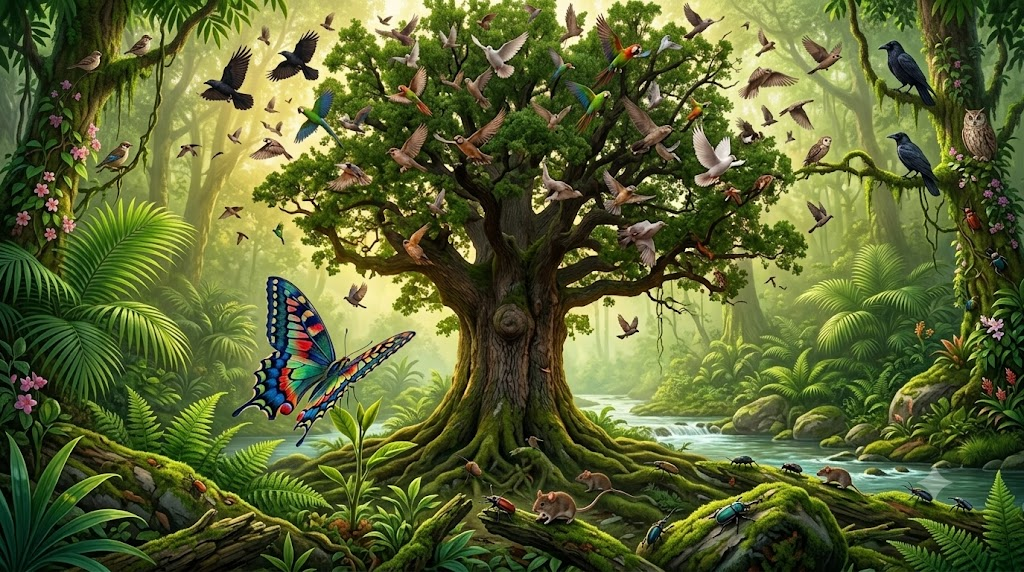
Highest of all, near the very top where the wind blew strongest, lived a pair of ravens. The ravens were sleek and clever and very fond of themselves. They kept the best branch—the widest, the most sheltered from rain—entirely to their own two selves. If any smaller bird so much as looked at it hopefully, the ravens would clack their beaks together sharply and say, “Ours. Find your own.”
“They’re not unkind, exactly,” Cedric said once to the wind, which was the only one who ever really listened to his private opinions. “Just… terribly interested in themselves.”
Lower down, tucked into a snug fork of branch and leaf, lived a sparrow named Marigold, and her five small, fluffy, endlessly hungry chicks. Marigold was, without question, the hardest-working bird in the whole tree. From the very first grey light of morning until the sun had long since gone down, she was flying—out to the meadow for seeds, down to the stream for insects, back again with a beak stuffed impossibly full—while her chicks squeaked and squabbled and demanded more, more, more.
“I don’t know how she does it,” Cedric would sigh admiringly, watching her dart past for the twentieth time before noon.
On the sunniest branch, showing off outrageously, lived a bright green parrot named Pico, who had no family of his own nearby but plenty of opinions about everyone else’s. Pico liked to hang upside down by one foot just to make the sparrow chicks laugh, and he liked even more to mimic the ravens’ haughty voices the moment their backs were turned, which never failed to send the whole tree into fits of giggigling that the ravens pretended very hard not to hear.
In the deep hollow near Cedric’s roots, where the wood had gone soft and cool, lived an owl named Bartholomew, who came alive only after dark. All day he slept, one eye occasionally cracking open at some especially loud parrot joke, and all night he glided silently between the branches, keeping watch, his great round eyes catching what little moonlight slipped through the leaves.
“Sleep well, old friend,” he would murmur to Cedric each evening as he stirred. “I’ll watch the forest tonight.”
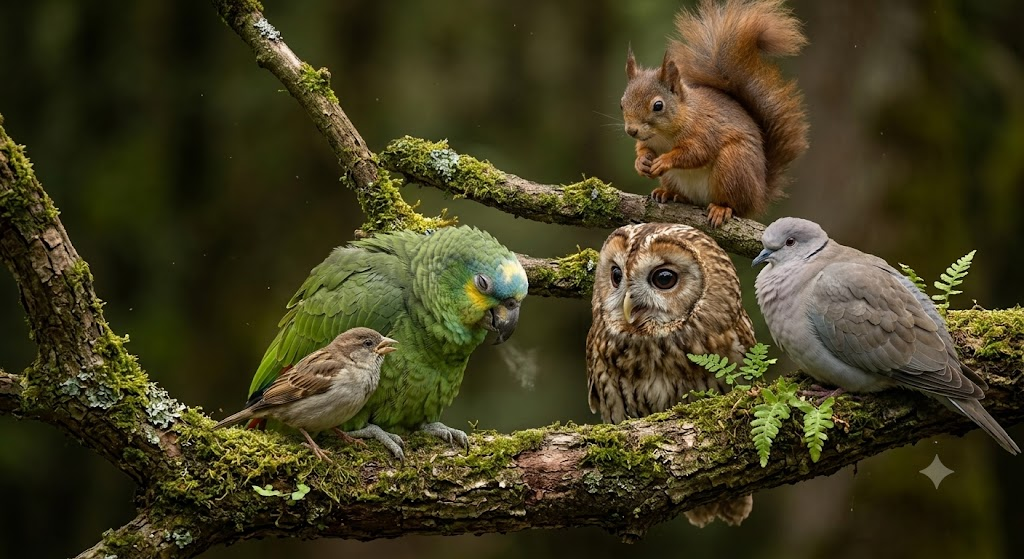
And then, one spring, a dove arrived—soft grey, quiet, a little unsure of herself, having lost her old home to a woodcutter’s axe two valleys over. She settled, shy and hesitant, on one of Cedric’s lower branches, and it was Marigold the sparrow who noticed her first and fluttered straight over.
“You’re new,” Marigold said kindly. “Don’t worry. This is a good tree. He’ll look after you.”
And Cedric, hearing this, felt something warm move through his old trunk, all the way down to his roots. A good tree. He rather liked being that.
Somewhere deeper in the forest—nobody quite knew where, and nobody could ever quite catch her—there lived a butterfly unlike any other.
She had no name that anyone had agreed on; the birds simply called her the Iris. If she touched a green leaf, it might turn gold, or deep crimson, or a blue so pale it looked like morning mist. If she rested a moment on grey bark, the bark would bloom, just briefly, with soft patterns like frost or lace. Even flowers, when she landed among their petals, would shift their color entirely, as though she were painting the whole forest, one small brushstroke at a time.
Cedric had felt her land on him only twice in all his long life—once on a low branch, which had turned the color of autumn fire though it was only June, and once, many years before that, on a single leaf near his very highest branch, which had shimmered silver for three whole days before fading back to green.
“She’s magic,” Pico the parrot always insisted. “Properly magic. I saw her turn a whole thornbush into something that looked like it was made of stained glass.”
“She’s just a butterfly,” the ravens sniffed, though even they always watched, just a little too closely, whenever she passed.
Cedric didn’t know what she was, exactly. But he loved the idea of her—a small, unhurried creature drifting through the forest, leaving small unexpected beauties behind her wherever she chose to rest, asking for nothing in return.
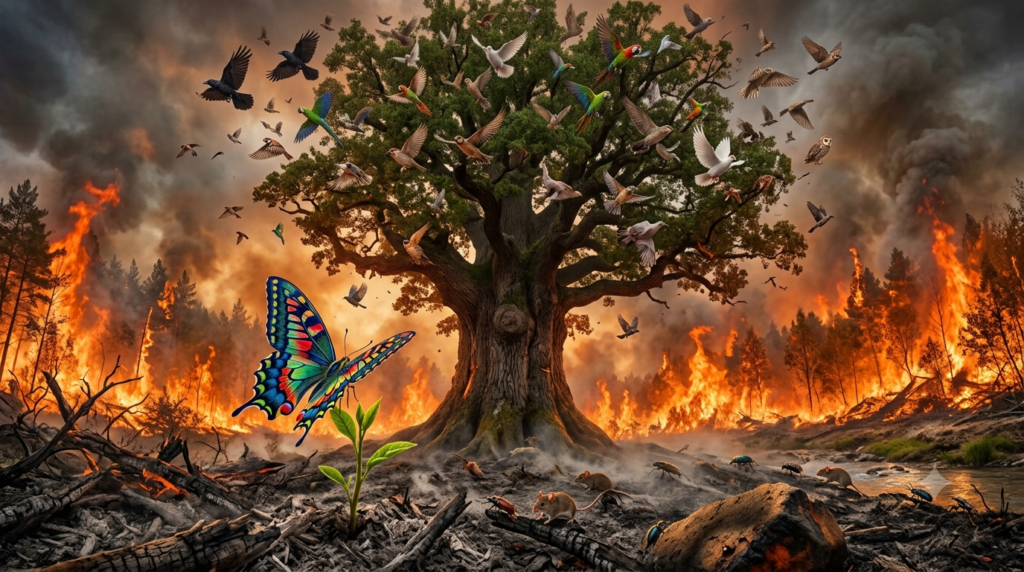
It was late summer, the driest anyone could remember, when the fire began—though at first, nobody in Cedric’s tree even knew to call it that.
It started far off as nothing more than a thin grey smudge low on the horizon, the kind of thing a bird might mistake for evening mist.
“Someone’s burning brush, probably,” Bartholomew murmured, barely opening one eye. “Happens most summers. It’ll pass.”
For two days, that seemed true enough. The smudge stayed distant, and life in the tree went on exactly as it always had. But on the third day, the wind changed.
It came from the wrong direction, hot and dry and restless, bringing a smell Cedric had never smelled before—sharp, bitter, wrong. The distant grey smudge was no longer distant. It had become a long, low line of orange, flickering at the edge of the world, and it was moving fast.
“Cedric.” It was Bartholomew, wide awake now, both great eyes open and fixed on the horizon. “That is not brush burning.”
What happened after that, Cedric would remember in flashes and sounds—the terrible orange light climbing closer through the dark.
He remembered the ravens, for once without their usual haughtiness, screaming warnings to every bird within earshot as they took to the sky. He remembered Marigold, frantic, shepherding her five chicks—not yet strong enough to fly far—out along the lowest branches toward the stream at the bottom of the hill. He remembered Pico circling back into the smoke to guide the terrified dove toward safety. He remembered Bartholomew gliding low through thick smoke to make sure every creature knew which way the water lay.
And then the fire reached Cedric.
Cedric did not fall that orange scrotching night, and it was not luck, and it was not magic.
His bark — thick, cracked, built up over a hundred patient years — burned on the outside while the living, moving part of him underneath stayed shielded, the way a coat keeps out rain long after its outside has gone soaking wet. Deep below, roots he had spread wide and sunk deep held reserves of sugar and water put by season after season, the way a careful person saves a little every year against a hard winter. And tucked beneath his bark, all along his trunk, small sleeping buds waited — ready, even now, to push fresh green growth from wood that looked, from the outside, entirely finished.
A younger tree, thin-barked, shallow-rooted, would not have survived that night at all.
Cedric’s hundred years had built him, without his ever noticing, into exactly the kind of tree a fire could scorch and still not kill.
In the midst of the heat, a desperate flutter caught the edge of his sight.
It was the Iris. She had been caught in the sudden draft of smoke. The hot, ash-filled air had swept her out of the sky and choked her delicate lungs. She tumbled through the blazing air, crashing hard onto Cedric’s thick trunk, just above the flames.
She was alive, but barely. The thick smoke had nearly smothered her. The fierce heat had scorched her brilliant, rainbow-patterned wings, leaving dark, dull black patches across their edges.
The fire burned for two full days before rain finally fell. When it passed, the forest was barely recognizable. Whole stretches of the hillside stood black and bare. Cedric—scorched, blackened along one side, half his lower branches gone—was still standing. But he was no longer beautiful. His bark was cracked and charred, and his remaining leaves hung sparse and dry. He did not sway for the joy of it anymore; he barely moved at all.
They came back one by one, over the following week, to a hillside gone black and bare.
Marigold returned first, her five chicks, grown up a little singed but whole, and touched down on a burnt branch, and simply sat there, looking at the ruin of the only home she’d known.
“Is he—” she started.
“He’s here.” Bartholomew’s voice, from the hollow. Blackened, cracked along one side, half his lower branches gone — but Cedric was still standing.
Pico landed next, then the dove, then, quietly, the ravens.
For days, everyone watched the sky for one more shape.
“She’ll come,” Pico said, the first evening. “She always comes back.”
She did not come the second evening either. Or the third. By the end of the week, nobody was saying she’ll come anymore.
“She flew too low,” Marigold said finally, very quietly, to no one. “She must have.”
Pico didn’t argue. For once, he had nothing funny to say at all.
They mourned her the way you mourn something you never got to thank — a small silence that settled over the whole tree, and did not lift.
Only the ravens said nothing, and looked at nothing, and seemed, if anyone had thought to notice, unusually careful about which way they turned their heads.
Weeks later, gliding his slow circuit through the blackened branches at night, Bartholomew stopped mid-flight.
The male raven was asleep on his branch, beak tucked under one wing — and where a sliver of moonlight touched it, the beak was shining. Not black. Gold, for half a second. Then silver-blue. Then black again, as if it had never happened.
Bartholomew did not blink. He watched for three more nights, from three more angles, until he was certain his old eyes hadn’t tricked him.
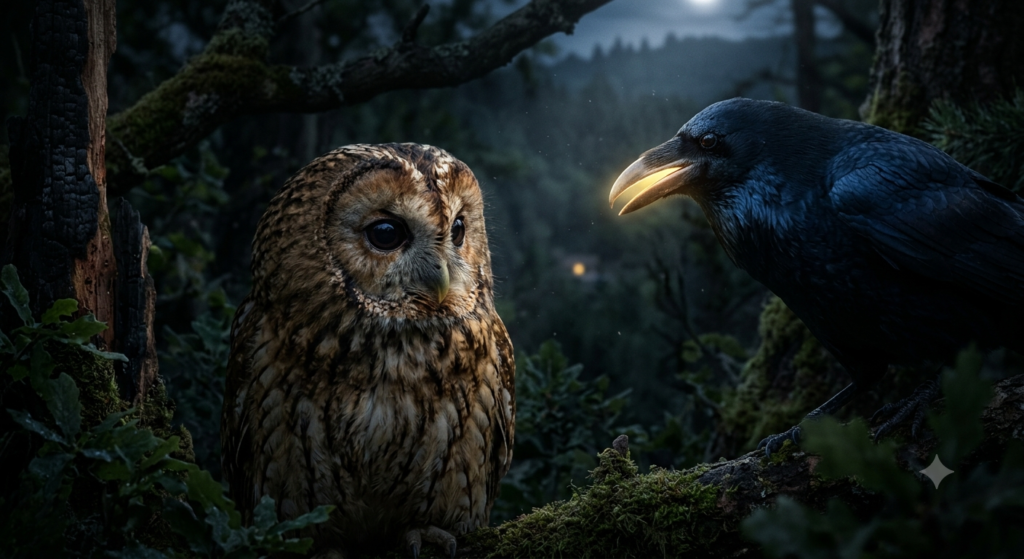
On the fourth night, he didn’t watch. He landed, silent, directly in front of the sleeping raven, and said, low and even:
“Where did you get that color on your beak?”
The raven’s eyes snapped open. “What color.”
“You know what color.”
“I don’t know what you’re—”
“I have watched this tree for forty years,” Bartholomew said. “I know every color that has ever belonged in it. That one isn’t yours.”
By morning, the whole tree knew.
They gathered on the ravens’ own branch — Marigold, Pico, the dove, Bartholomew, every finch and sparrow who had ever been chased off that branch with a snapped ours — and even Cedric himself seemed to lean in closer, every twig gone still and listening.
“Tell them,” Bartholomew said. “Or I will.”
The raven backed along the branch until there was no more branch left. “I didn’t mean—”
“TELL THEM.”
“I only wanted a little of it!” The words tore out of him all at once. “There’s an old story — that if you take a piece of her, just a piece, some of what she can do stays with you — I never meant to hurt her, I only took a little, just at the edge of her wing, in the smoke, when no one could—”
The tree erupted.
Marigold’s five chicks screamed at once. Pico dove straight at the raven’s head, shouting something that was not remotely funny anymore. The dove, of all birds, flew directly at his face, wings beating, driving him back along the branch. Even the smallest finches came, wheeling in from every direction, until the raven and his silent, frozen mate were surrounded on every side by beaks and wings and one furious, roaring chorus of birds who had spent a whole week mourning a friend this raven had never even told them might still be alive.
“GET OUT,” Marigold screamed, closer to his face than she had ever dared come before. “GET OUT OF THIS TREE—”
The raven did not wait to be told twice. He tore free of the branch in a panic, wings beating wildly, feathers scattering — and did not look back, not once, terrified that if Iris ever did return, or even if she never did, this tree would come for him regardless.
He flew west, over the blackened hill, over the valley, until he was nothing but a small dark shape and then nothing at all.
No one in that tree ever saw him again. To this day, none of them know where he went.
His mate followed him.
It was Marigold who found her.
Three days after the raven fled, drawn by nothing more than habit, she landed on the low, scorched patch of bark near Cedric’s roots — and stopped.
Something moved in the crack.
“Iris?”
A wing — thin, singed at one edge where a small piece was simply gone, but a wing all the same — unfolded slowly into the light.
“I couldn’t fly,” Iris said, so quietly Marigold nearly missed it. “For weeks. I didn’t know why. I only knew that when I stayed here, in this crack, breathing whatever this old bark was breathing out — I felt a little stronger, every day. A little more.”
Marigold didn’t ask about the missing piece of her wing. Not yet. There would be time for that.
“You’re alive,” she said instead, and it came out half a laugh, half something much rawer. “You’re alive — everyone thought — Pico, PICO, come here, come see—”
By the time the whole tree had gathered again — properly this time, joyfully this time — Iris had climbed, slow and careful, onto the very crack that had hidden her, and rested there a long moment.
Beneath her, gold and green bloomed slowly through the black, threading upward like new growth pushing through old ash.
It was not everything. Her wing would always carry that small, missing edge. But it was something, and it was hers, and the whole tree — sparrow, parrot, dove, one old wise owl, and every small hungry chick among them — leaned in together to watch it happen.
Cedric felt the wind come curling down the valley at last, and swayed to it, slow and careful, his scorched branches lifting one by one.
It was not quite his old song.
But it was music all the same.
Pingback: Didy’s Flight – The Sparrows of Cedric - E.CODI
Pingback: The Black Leaves Of Yeniz - E.CODI