This story is the direct sequel to The Chocolate Apple Tree (Part 1), where three adventurous friends—Milo, Zara, and Buttons—discovered a magical tree in their local park that grew genuine, delicious chocolate apples.
Not far from the village, in a shiny office with too many glass windows, there lived a businessman named Mr. Bumblecash.
Mr. Bumblecash loved exactly two things in this world: money, and more money.
When he heard the story of the chocolate apple tree — the one Milo, Zara, and Buttons had found, the one the whole village now shared — his eyes lit up like two shiny coins.
“A tree that grows CHOCOLATE apples?” he said, rubbing his hands together the exact same way Sly Ferguson used to. “If I had a hundred of those trees, I could sell chocolate apples to the entire COUNTRY! I’d be the richest man alive!”
So, very early one morning, before anyone in the village was awake, Mr. Bumblecash tiptoed to the park with a little bag and quietly collected seeds from the fallen chocolate apples.
He bought a huge, empty field on the edge of town. He hired workers. He planted rows and rows and ROWS of apple seeds, dreaming of an entire forest of chocolate.
“Soon,” he told his manager, a nervous little man named Mr. Prunefeather, “I will have a thousand chocolate apple trees, and I will never have to share a single one with those pesky village children.”
Mr. Bumblecash waited. And waited. Growing trees takes a very long time — much longer than growing patience, which Mr. Bumblecash did not have very much of either.
Finally, after a long wait, the trees grew tall, and the apples came.
Mr. Bumblecash rushed out to the field, grabbed the very first apple, and took an enormous, greedy bite.
It tasted like… an apple.
Just a regular apple.
No chocolate. No magic. Nothing special at all.
“WHAT?!” Mr. Bumblecash shouted, apple juice dripping down his chin in the least chocolatey way possible.
He tried another apple. Regular. Another. Regular. Another — this one was already going soft and brown and mushy, rotting far too early, weeks before it should have.
He tried a hundred more apples across his huge field. Every single one was completely normal — and worse, many of them were rotting almost as soon as they ripened, turning brown and squishy and sad.
It turns out that magic trees do not work quite so simply. You cannot just plant a few seeds and expect chocolate to grow. That one special tree in the park had its own secret — a secret that seeds alone could not copy.
Mr. Bumblecash had spent every last coin of his savings on a giant field of extremely ordinary, extremely rotten apples.
He sat down in the dirt and put his head in his hands.
“I have lost EVERYTHING,” he moaned.
Now, Mr. Bumblecash was many things — greedy, impatient, and not very good at farming — but he was NOT the type of man to admit he had made a mistake.
Instead of telling anyone the truth, he called Mr. Prunefeather into his office and whispered a very sneaky plan.
“We will make our OWN chocolate apple flavor,” he said. “Not real chocolate apples — just chocolate flavoring, sprayed onto regular snacks. Nobody will know the difference!”
“But sir,” said Mr. Prunefeather nervously, “that’s not really—”
“Shhh,” said Mr. Bumblecash, sliding a small bag of gold coins across the desk. “This is for keeping quiet.”
Mr. Prunefeather looked at the coins for a long moment. Then he took them, and he stopped saying “but sir.”
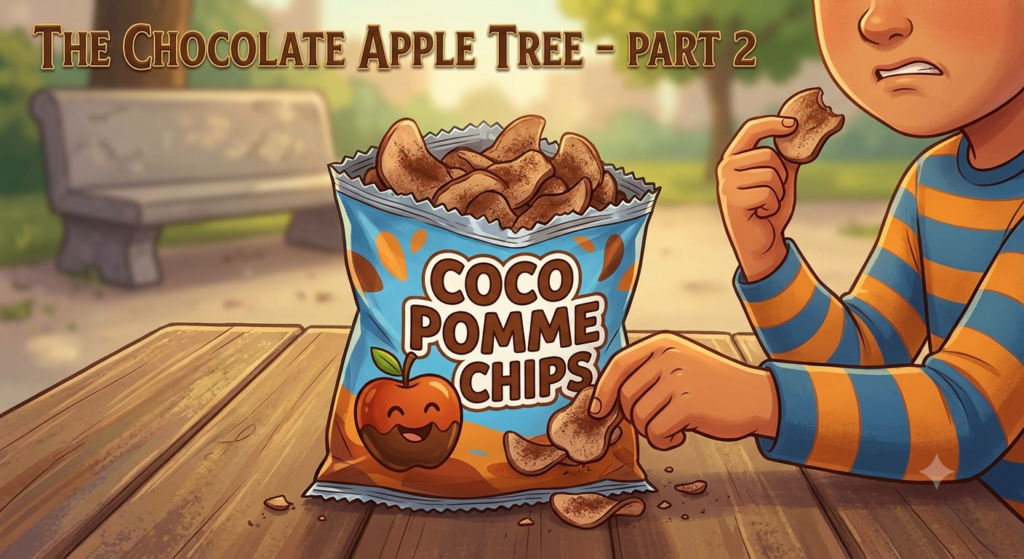
Soon, shiny new snacks appeared in shops all over the country: ChocoPomme Bites, fruity chocolate bars with a picture of a smiling apple on the wrapper, and Coco Pomme Chips, crunchy chips that promised “the taste of the famous chocolate apple tree!”
There was just one small problem. They were expensive. VERY expensive. So expensive that most kids could only stare at them through the shop window with their noses pressed against the glass.
But grown-ups with plenty of money bought bag after bag, licking their fingers and saying things like, “Oh, how delightfully unique!” and “Simply divine!” — even though, if we’re honest, the flavor was really just chocolate powder sprayed on regular chips.
Milo, Zara, and Buttons heard about Coco Pomme Chips at school, where two older kids were bragging loudly about how amazing they tasted.
“We HAVE to try them,” said Zara. “If it really tastes like our tree, that would be so cool!”
So the three friends did something very serious. They emptied their piggy banks. They skipped buying candy for two whole weeks. They even did extra chores — Buttons washed his neighbor’s car three times, even though it only needed washing once.
Finally, with their pockets jingling with hard-earned coins, they marched to the shop and bought one small, very expensive bag of Coco Pomme Chips.
They sat on their favorite bench and opened the bag together, hearts pounding with excitement.
Milo took the first bite. He chewed. He frowned. He chewed some more.
“That’s…” he said slowly, “not it.”
Zara tried one. “It just tastes like chocolate powder on a regular chip,” she said, disappointed. “It doesn’t taste anything like our tree.”
Buttons ate seven chips in a row, just to be extra sure, because he was a very scientific eater. “Nope,” he finally said. “Fake. Totally fake.”
They tried to convince themselves it was close enough. They really did. But deep down, all three of them knew: nothing tasted like their real, magical, secret tree in the park.
Milo told his parents. “It’s not the same! I think that businessman is tricking everyone!”
His parents just laughed. “Oh, sweetie, it’s still a nice treat. Don’t worry about it so much.”
Zara told her uncle, who worked at a bank and loved anything that sounded official. “It’s called marketing, Zara. Companies exaggerate all the time. It’s normal.”
Buttons even bravely walked into the small village police station and told the officer at the desk, very seriously, “I think Mr. Bumblecash is lying about his chips!”
The officer chuckled and patted Buttons on the head. “That’s a big word for a little boy — ‘lying.’ Go on home now.”
Nobody took them seriously. Not one single grown-up.
The three friends sat on their bench that evening, feeling very small and very ignored.
“Fine,” said Milo, crossing his arms with a determined look on his face. “If nobody will believe us… we’ll go see the truth ourselves.”
“You mean,” said Zara slowly, “go to his garden? The one everybody says is closed off?”
“Exactly,” said Milo.
Mr. Bumblecash’s giant field was surrounded by a tall metal fence with a big sign that read:
PRIVATE PROPERTY — DO NOT ENTER — SERIOUSLY, WE MEAN IT
Two large, grumpy guards stood at the gate.
The three friends walked up bravely, trying their best “innocent kid” faces.
“Um, hello,” said Zara sweetly. “We’re just… students! Yes! Doing a school project! About… gardens! Can we please look around for just a teeny tiny minute?”
The guards did not even blink. “No.”
Buttons tried next. “We heard there might be some chocolate apples that fell over the fence, and we just wanted to check if any rolled onto the sidewalk, which is technically public property—”
“No,” said the guards again, arms crossed like two brick walls.
Milo tried the biggest, most dramatic sad face he could make. It did not work either.
The three friends walked away from the fence, completely stuck.
“That’s it,” Milo announced that night, pacing back and forth in his treehouse. “If the guards won’t let us in, and the police officer won’t listen to us, then we go BIGGER. We go to the Main Police Secretariat downtown and report this whole thing as fraud.”
Zara’s eyes went wide. “Milo, that’s the grown-up police building! The really serious one! We’re just kids — what if they don’t believe us either? What if we get in trouble for wasting their time?”
“What if they laugh at us?” added Buttons nervously. “What if it’s scary in there?”
“Maybe,” said Milo, “but what if we’re right? Somebody has to say something, even if it’s scary. Even if it’s just us.”
Zara and Buttons looked at each other. They were not sure. Their tummies felt full of nervous butterflies. But they also remembered the taste of that first real chocolate apple, and how happy their whole village had been to share it — and how wrong it felt that someone was now lying about it for money.
“Okay,” Zara finally said, taking a deep breath. “Let’s do it. Together.”
The next morning, three kids in slightly wrinkled clothes walked straight through the big glass doors of the Main Police Secretariat, marched up to the front desk, and Milo — voice shaking just a little, but loud and clear — said:
“Excuse me. We would like to report a business fraud.”
A tall police captain, who had heard a lot of silly complaints in her long career, almost sent them home.
But something about the way all three kids told the exact same story, with the exact same details, the exact same tree, the exact same taste, and the exact same disappointment — made her pause.
“Tell me everything,” she said instead, pulling out a notebook. “From the very beginning.”
It took a full week of investigating. Police officers visited Mr. Bumblecash’s field and tested his apples themselves — regular, and quite a few rotten. They interviewed Mr. Prunefeather, who, once the gold coins were taken away as evidence, suddenly remembered how to say “but sir” again, and told the police absolutely everything.
The newspapers printed the whole story the very next morning:
“BUSINESSMAN’S CHOCOLATE APPLE EMPIRE WAS FAKE, SAY POLICE — THREE LOCAL CHILDREN CRACK THE CASE
Mr. Bumblecash was fined every last coin he had left, ChocoPomme Bites and Coco Pomme Chips were pulled from every shop shelf in the country, and Mr. Bumblecash’s giant, useless field of rotten apples was finally given back to the village — where, this time, real fruit trees were planted properly, with plenty of sunshine and absolutely zero shortcuts.
Milo, Zara, and Buttons became just a little bit famous around town — not for pranks this time, but for being brave enough to keep saying the truth, even when every grown-up told them to stop.
“You know,” said Zara, munching happily on a REAL chocolate apple from their very own tree in the park, “being ignored is annoying. But being right? That’s the best snack of all.”
“Almost as good as chocolate,” Buttons agreed, reaching for his second apple.
“Almost,” laughed Milo. “Nothing beats chocolate.”