The swings behind Green Hollow Primary creaked in the late afternoon wind, and that creak was the last ordinary sound Rose Hale would remember from that Tuesday, though of course she didn’t know it yet. She only knew that she’d finally beaten Meesha at tennis for the first time in three weeks, and that the win had made her so gleeful she’d forgotten, for a whole glorious hour, to be a good sport about it.
“Best of five next time,” Meesha said, laughing, dropping her green backpack beside the swing set the way she always did — the same worn green bag with the small embroidered flower on the front pocket, stitched there years ago by her grandmother’s careful hands. “You only won because I let you.”
“You did not let me win,” Rose said, indignant, already pushing off into the air. “Say it. Say I’m better.”
“Never,” said Meesha, grinning, and swung up beside her.
They stayed later than they meant to, the way they usually did, the sky over Solhaven turning that soft gold color it always turned in the hour before dinner — the light catching on the river beyond the school fence, on the far green smudge of the forest, on the rooftops of a city that had never, in living memory, given any of its people a real reason to worry about anything much at all. It was, everyone agreed, a wonderful place to grow up. Rose’s mother taught right here, in fact, in the very same building, which meant Rose spent her mornings being both “sweetheart” at breakfast and “Miss Rose, please pay attention” during arithmetic — a state of affairs she found only slightly less humiliating than falling down in front of the whole class.
It was only when the streetlights flickered on that the girls finally gathered themselves to leave, and it was only then that Meesha looked down at the grass beside the swings and went very still.
“Where’s my bag?”
They searched everywhere. The classroom, empty and locked. The bushes along the fence. Under the slide, behind the bins, twice around the whole playground in the fading light until Rose’s own mother came out calling for her, wondering what on earth was taking so long. Meesha’s eyes had gone glassy by then, though she was trying hard not to show it.
“My homework’s in there,” she said quietly, on the walk home, her voice smaller than Rose had ever heard it. “My mom’s old calculator. I don’t — we don’t really have money to just buy another one.”
Rose knew this without being told, the way you know certain things about your best friend without either of you ever saying them out loud. She knew that Meesha lived above a shoe repair shop near the market district, in two small rooms she shared with her parents. She knew that Meesha’s father, a big, warm-voiced man everyone in the neighborhood called Baba Elom, spent six days a week standing outside Riverside Park with a cart he’d built himself, selling paper cones of fried chips seasoned with a spice mix so good that people crossed half the city just to buy from him — and that even so, there were weeks that stretched thin, weeks where a lost calculator was not a small thing at all.
“We’ll find it,” Rose said, squeezing her hand. “I promise.”
The school administration promised to “look into it,” which turned out to mean very little happened for two full days. It was Rose’s older sister, Kyra, who finally suggested that someone had probably grabbed the wrong bag by mistake, since half the school seemed to own the exact same green backpack from the exact same shop on Miller Street.
She turned out to be right. On the third day, a small boy from the year below, a quiet kid with thick glasses that Rose vaguely recognized from the bus stop, was found still carrying Meesha’s bag, having mistaken it for his own nearly identical one. His grandmother, apparently, had only just noticed that the flower stitched on the front pocket didn’t belong to her grandson at all.
The bag came back. The books were all there, a little rumpled but otherwise fine. Everyone breathed out, called it a silly accident, and moved on with the particular speed that children move on from things that turn out, in the end, not to matter.
Rose mostly forgot about it too. Mostly.
It was two days later, home sick with a mild fever and missing an assignment, that she borrowed Meesha’s math textbook to copy down the homework she’d missed — and flipped, without thinking much of it, to Exercise 7.3.
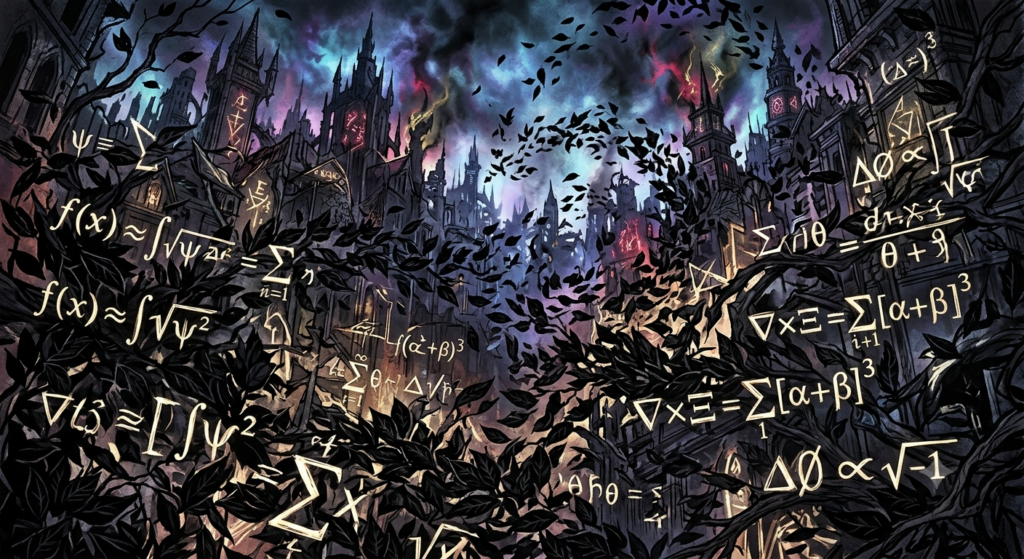
Only it wasn’t Exercise 7.3. Not really. Where there should have been ordinary fractions, or maybe long division, the kind of dull arithmetic that filled every other page of the book, there was instead a tight little block of symbols Rose had never seen before. Not numbers. Not quite letters either. Curling, angular little marks, arranged in careful rows like a code someone had gone to a great deal of trouble to write out neatly.
She checked the rest of the book. Every other page was completely normal. She checked her own copy of the same textbook later that evening, and Kyra’s copy too — both showed the ordinary Exercise 7.3, the one about dividing fractions, exactly as it was supposed to be.
Only Meesha’s book was different.
Rose had always been what her father fondly called “a tricky-minded kid” — the sort who read mystery novels under her blanket with a flashlight long after she was supposed to be asleep, who noticed the things other people walked straight past. So instead of saying anything to Meesha at all, she copied every symbol carefully into her own notebook that night, line for line, and returned the textbook the next morning as if nothing were unusual in the slightest.
That evening, she brought her notebook to Kyra’s room.
Kyra was twelve, two years ahead of where she was supposed to be in school, the kind of student teachers spoke about in hushed, admiring tones in the staff room — and she took one look at Rose’s careful copy of the strange symbols and immediately forgot whatever she’d been doing before.
“Where did you even find this?”
“Just tell me if you can solve it,” Rose said, which was, she knew, exactly the right way to get her sister’s full attention.
Kyra worked at it for nearly an hour, treating the marks like an unfamiliar kind of algebra, testing values, rearranging patterns, until one by one the strange symbols began giving way to ordinary numbers beneath her pencil. All of them, that is, except the very last line, which refused to balance no matter what she tried, sitting there like a locked door with no visible key.
“This one’s not solvable,” Kyra finally admitted, rubbing her eyes. “Not with anything I know, anyway.”
“Then maybe,” Rose said slowly, “it’s not the kind of math you’re supposed to know.”
Kyra gave her the look — the specific older-sister look that meant don’t be dramatic, Rose — but Rose barely noticed. She was already turning the puzzle over in her mind the way she turned over the pages of her favorite books, hunting for whatever clue the writer had hidden in plain sight.
Over the next several evenings, she couldn’t let it go. She photographed every symbol from her notebook onto the family computer in the study, enlarged each one until she’d memorized its every curl, and searched anything she could think to search — cryptography forums, invented-alphabet websites, puzzle groups built for exactly this sort of stubborn curiosity. Most of it led nowhere useful. Interesting, sometimes, but nowhere close to an answer.
Then, late one evening, at the very bottom of her seventeenth search — well past the point where anyone more sensible would have given up and gone to bed — she found it. A single broken-looking result, sitting at the edge of the page with no description beneath it, no image, nothing but five small grey words:
the black leaves of yeniz
Rose’s heart gave an odd little thump. She glanced over her shoulder at the empty study, though there was no reason to, and clicked.
The page began to load, white against the dark of her screen.
And then, cold and final:
ERROR 404 — PAGE NOT FOUND.
She sat back in her chair. The house was silent except for the low hum of the refrigerator two floors down, and somewhere outside, faint and far off, a dog barking at nothing.
Whatever “the black leaves of Yeniz” had once been, Rose was suddenly, completely certain of one thing: it had existed. Somebody, or something, had gone to a great deal of trouble to erase it.
And whatever it was, she thought, closing her notebook slowly, it had something to do with a missing green backpack that everyone else in the world had already forgotten about.
……………
….
To be continued in Episode Two– COMING SOON