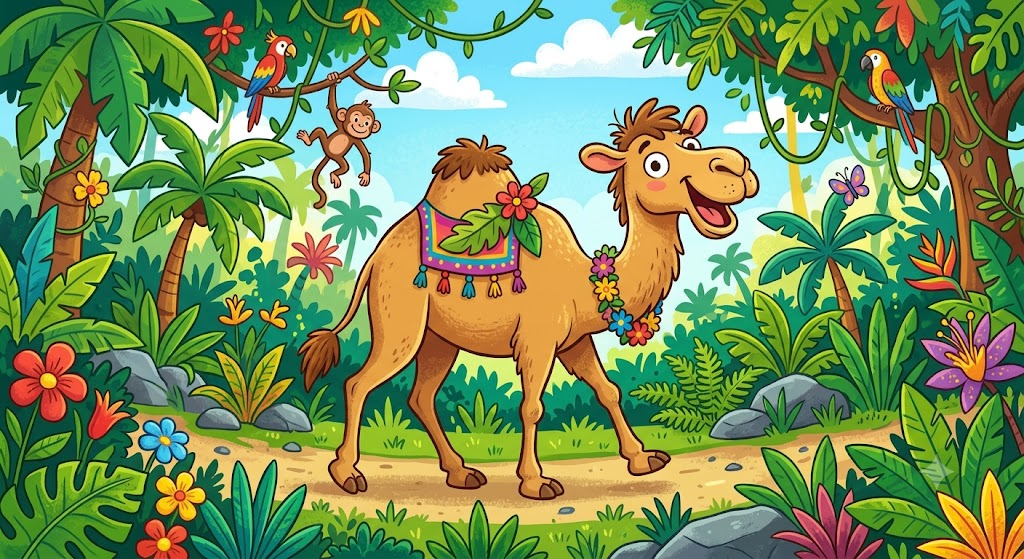
Once upon a hot, sandy afternoon, in a desert as golden as toast, lived a camel named Cornelius.
Cornelius was a very proud camel. He had two excellent humps, extremely long eyelashes (which he batted at anyone who admired them), and he could go for two whole weeks without a sip of water — a fact he mentioned to absolutely everyone, whether they asked or not.
“Two weeks!” he would announce to a passing scorpion. “TWO. WEEKS. Without water! Can you do that?”
The scorpion, who did not care even a little bit, usually just scuttled away.
One day, a strange wind came blowing across the desert — a wind that smelled, very oddly, of leaves. Cornelius sniffed the air with his big camel nostrils.
“Leaves?” he said, puzzled. “In the desert? That’s simply not correct.”
Being a curious camel (and, if we’re honest, a very bored one, since the nearest cactus was forty minutes away), Cornelius decided to follow the leafy smell. He walked. And walked. And walked some more, his big flat feet going floomp, floomp, floomp in the sand.
And then, quite suddenly, the sand ended.
Cornelius blinked. In front of him was not sand at all, but a thick, tangled, dripping, buzzing, chirping, extremely green jungle.
“Well,” said Cornelius, staring at it. “That’s new.”
He should have turned around right then. Any sensible camel would have turned around right then. But Cornelius was not always a sensible camel, and also his hump was itchy, and he thought maybe a leaf might help scratch it, so in he wandered.
Floomp. Floomp. Floomp.
Almost immediately, things started going wrong.
First, a vine reached down — or so it seemed to Cornelius — and yanked his tail. He spun around with a startled “HONK!” (camels do not honk, but Cornelius made an exception), only to find it was just a vine, hanging there, minding its own business.
“Rude,” Cornelius told the vine, and kept walking.
Next, he tried to take a nice long drink from what he thought was a peaceful, still pond.
It was not a pond. It was a very large, very surprised crocodile.
“EXCUSE YOU,” said the crocodile, snapping his jaws shut just as Cornelius yanked his nose back at approximately the speed of light.
“My deepest apologies,” said Cornelius, backing away with as much dignity as a camel can manage while also sweating with fright. “I thought you were water.”
“I get that a lot,” sighed the crocodile, and went back to sleep.
Then Cornelius tried to nibble on a bush, the way he nibbled the occasional prickly desert shrub back home. Unfortunately, the bush turned out to be the tail end of a sleeping python, who was NOT thrilled about being nibbled.
“WHO,” boomed the python, uncoiling to a height that made Cornelius’s knees knock together, “IS EATING MY TAIL?”
“Terribly sorry! Thought you were lunch! I mean — thought you were a BUSH! Not lunch! Goodbye!” yelped Cornelius, and galloped off so fast that three monkeys fell out of their tree from laughing.
By now, poor Cornelius was thoroughly and completely lost. The jungle, it turned out, did not care one bit that he could go two weeks without water. Nobody was impressed. Nobody had even asked.
He sat down on a large mossy rock (which, thankfully, was actually a rock and not a hippo) and let out a very long, very dramatic camel sigh.
“I want to go home,” he said sadly. “Where the ground doesn’t hug your ankles and the water stays where you can see it.”
Also Read The Whispering Willow Tree
Just then, a small, chattering monkey named Pip swung down from a branch and landed neatly on Cornelius’s nearest hump.
“You’re the funniest thing I’ve seen all week,” Pip giggled. “A camel! In the JUNGLE! Nobody’s going to believe this.”
“I got lost,” Cornelius admitted glumly. “I followed a leafy smell. It seemed like a good idea at the time.”
Pip looked at him thoughtfully, tilting her little head. “You’re not built for jungles, you know. Your feet are made for sand, not mud. That’s probably why you keep sinking.”
Cornelius looked down. Sure enough, his enormous flat feet — perfect for sand — were sunk nearly up to his ankles in squelchy jungle mud, making a sound like SHLORP every time he tried to lift one.
“Oh,” he said. “That explains a great deal.”
“Come on,” said Pip, patting his hump. “I know this jungle like the back of my paw. I’ll show you the way out — but only,” she added, grinning, “if you tell me the story about the crocodile again. That was the best part.”
So Cornelius told her the whole story — the vine, the crocodile, the python — making it a little bit funnier and a little bit braver with every telling (as good stories tend to become), while Pip led him, hop by hop and branch by branch, back toward the edge of the trees.
When at last the jungle thinned out and the golden desert stretched before him again, warm and dry and blessedly free of ponds that snapped and bushes that hissed, Cornelius let out a happy honk of relief.
“Home!” he cried, flopping down dramatically in the sand like it was the softest cushion in the world.
“You know,” said Pip, hanging upside down from the last jungle branch to wave goodbye, “you’re not so bad, for a camel who thinks crocodiles are ponds.”
“And you’re not so bad,” Cornelius replied, “for a very small, very cheeky monkey. Do visit sometime. I’ll show you how a camel drinks water properly. Very impressive. Two weeks between sips, you know.”
“You mentioned that,” said Pip. “About nine times.”
And from that day on, Cornelius stayed happily in his desert, sand between his toes, water where he could see it — though every once in a while, on a very hot afternoon, he liked to close his eyes and remember the strange, green, buzzing jungle, and the crocodile who was very rude about being mistaken for a pond.
The End.